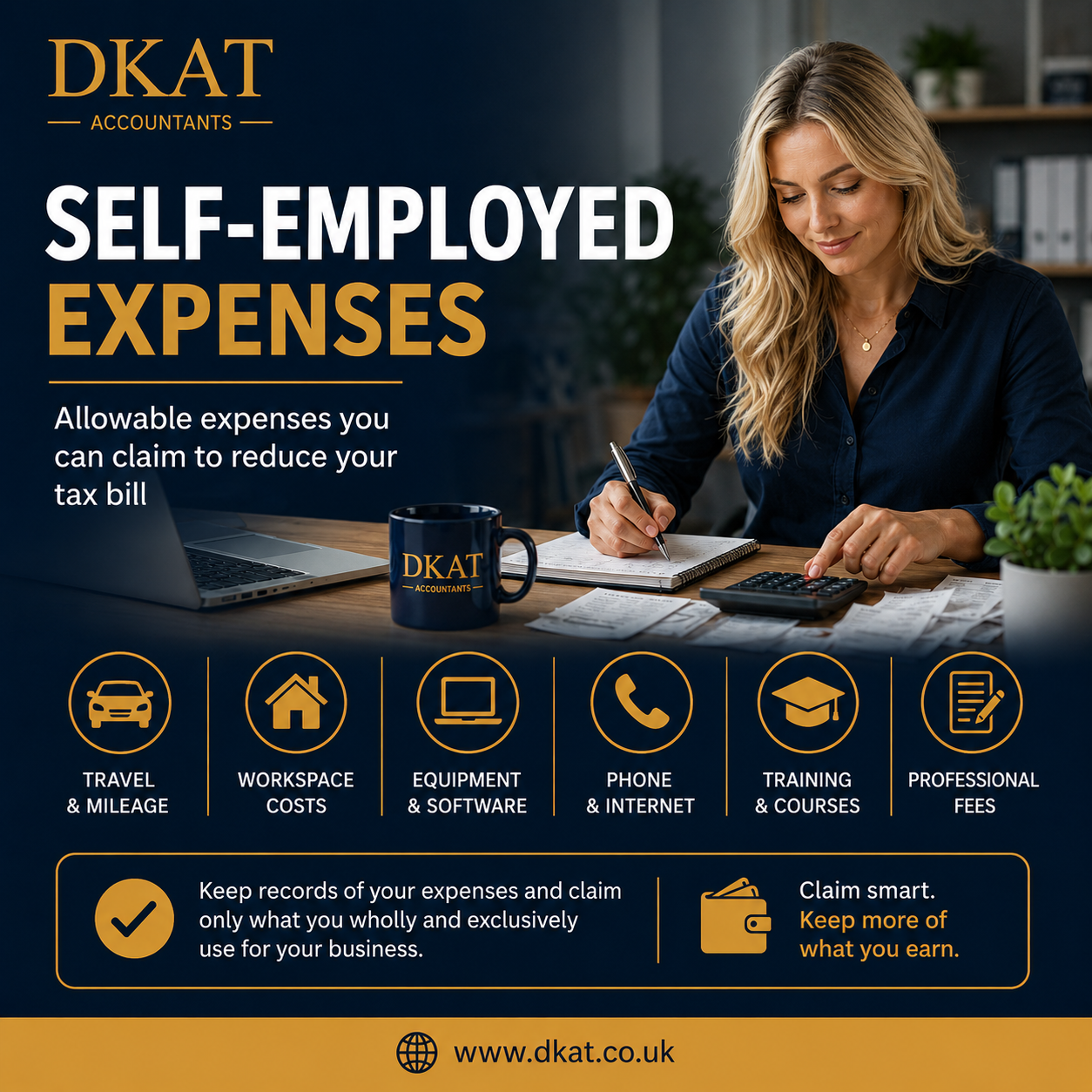
As a self-employed sole trader in the UK, you can claim expenses that are "wholly and exclusively" for business purposes, reducing your taxable profit. Common allowable expenses include office costs (stationery, software), travel (45p/mile for the first 10,000 business miles by car), home office costs (via simplified flat rates or actual cost apportionment), tools and equipment, marketing and website costs, professional fees (accountant, insurance), staff costs, and training that maintains existing skills. If your turnover is under £1,000 a year, the trading allowance lets you skip expense tracking entirely. Anything with mixed personal and business use must be apportioned fairly, and HMRC does not allow client entertaining or clothing beyond specific uniforms/protective wear.
- The "wholly and exclusively" rule
- Office costs and equipment
- Travel and mileage
- Working from home
- Staff and subcontractor costs
- Marketing, professional fees and insurance
- Training and clothing — what's allowed and what isn't
- The £1,000 trading allowance
- What you cannot claim
- Records you need to keep
- Frequently asked questions
Every allowable expense you correctly claim reduces your taxable profit, and therefore your Income Tax and Class 4 National Insurance bill. Yet many self-employed people under-claim simply because they aren't sure what actually qualifies, or over-claim in ways that create real risk if HMRC ever asks questions. This guide sets out exactly what you can and cannot claim as a sole trader in the UK for 2026.
01 The "wholly and exclusively" rule
The foundation of all allowable expenses is the statutory test in Income Tax (Trading and Other Income) Act 2005, s.34: an expense is only deductible if it is incurred "wholly and exclusively" for the purposes of the trade. Where an expense has a dual purpose (part business, part personal), it generally cannot be claimed at all — unless a clearly identifiable, distinct business proportion can be separated out, in which case that proportion alone is allowable.
In practice: A laptop used 70% for client work and 30% for personal browsing can typically have 70% of its cost claimed, since the business proportion is identifiable. A suit worn for client meetings but also for personal occasions cannot be claimed at all, because there is no way to separate "business use" of ordinary clothing from personal use.
02 Office costs and equipment
Stationery, postage and printing
Pens, paper, printer ink, postage stamps, and printing costs directly related to running your business.
Software and subscriptions
Accounting software (Xero, QuickBooks), industry-specific tools, cloud storage, and business-relevant subscriptions. If used partly for personal purposes, apportion accordingly.
Tools and small equipment
Hand tools, specialist equipment, and small assets used for the trade. Larger equipment (computers, machinery, vehicles) is usually claimed through capital allowances rather than as a simple revenue expense — most small businesses use the Annual Investment Allowance to get a 100% deduction in the year of purchase.
Phone and internet
The business-use proportion of your phone and internet bills. If you have a dedicated business line, claim it in full; if it's a personal phone also used for business, apportion based on genuine usage (e.g. by call/data records or a reasonable estimate).
03 Travel and mileage
Travel between your home/office and a client site, or between business locations, is generally allowable. Ordinary commuting to a single fixed place of work is not. Two methods exist for claiming vehicle costs:
| Method | How it works | Best suited to |
|---|---|---|
| Simplified mileage rate | 45p/mile for the first 10,000 business miles, 25p/mile thereafter (cars/vans); 24p/mile (motorcycles); 20p/mile (bicycles) | Most sole traders — simple, no need to track actual running costs |
| Actual costs method | Claim the business-use percentage of fuel, insurance, repairs, and capital allowances on the vehicle | Higher-mileage drivers or those with expensive-to-run vehicles, where actual costs exceed the simplified rate |
You must choose one method and stick with it for that vehicle for as long as you use it in the business. Switching between simplified mileage and actual costs for the same vehicle partway through is not permitted under HMRC's simplified expenses rules.
Other allowable travel costs include train and bus fares for business trips, parking (but not parking fines), and reasonable subsistence (food and drink) costs when travelling away from your normal working pattern for business purposes — not your everyday lunch.
04 Working from home
If you work from home, you can claim a proportion of household costs relevant to your business use, using one of two approaches:
| Hours worked from home per month | Simplified flat rate claim |
|---|---|
| 25 to 50 hours | £10/month |
| 51 to 100 hours | £18/month |
| 101+ hours | £26/month |
Alternatively, the actual cost method apportions a fair business-use share of rent/mortgage interest, council tax, utilities, and home insurance, typically based on the number of rooms used for business relative to the total, and the proportion of time spent working. This can produce a larger claim than the flat rate if your home office genuinely occupies significant space, but requires more detailed record-keeping and a clear, defensible apportionment method.
05 Staff and subcontractor costs
- Employee salaries, employer National Insurance, and pension contributions
- Subcontractor payments for work genuinely subcontracted (subject to CIS deduction rules if in construction)
- Recruitment agency fees
- Employee training costs directly relevant to their role in your business
- Employer's liability insurance, where you have employees
06 Marketing, professional fees and insurance
Marketing and advertising
Website hosting and design, online ads, printed marketing materials, business cards, and directory listings.
Professional and financial fees
Accountancy fees, bookkeeping software, bank charges on a business account, and interest on business loans or overdrafts.
Business insurance
Public liability insurance, professional indemnity insurance, and insurance covering business equipment or premises.
07 Training and clothing — what's allowed and what isn't
This is one of the most misunderstood areas of self-employed expenses:
| Category | Allowable? | Why |
|---|---|---|
| Training to update/maintain existing skills | Yes | Directly relevant to the trade you already carry on |
| Training for a brand new skill or qualification | Generally no | HMRC treats this as a capital cost of acquiring a new capability, not a revenue expense of the existing trade |
| Uniforms and specific protective clothing | Yes | Genuinely distinct from everyday wear (e.g. hi-vis, branded uniform, safety boots) |
| Ordinary clothing, even if worn only for work | No | Has "duality of purpose" — it could be worn outside work regardless of intent |
08 The £1,000 trading allowance
If your gross trading income (before expenses) is under £1,000 in a tax year, you can use the trading allowance instead of claiming actual expenses. This deducts £1,000 from your income automatically, meaning you don't need to track or report any expenses at all for that income. If your actual expenses are lower than £1,000, the trading allowance produces a better result; if your genuine expenses exceed £1,000, claiming actual expenses is more beneficial instead. You cannot use both the trading allowance and claim actual expenses on the same income — it's one or the other.
09 What you cannot claim
- Client entertaining — meals, drinks or entertainment provided to clients or customers are specifically disallowed under ITTOIA 2005, s.45, regardless of genuine business purpose
- Fines and penalties — parking fines, speeding fines, and HMRC penalties are never deductible
- Ordinary clothing — even if bought specifically to look professional for client meetings
- Your own wages or "salary" — as a sole trader, your profit is your income; you cannot pay yourself a wage and claim it as an expense
- Non-business travel — ordinary commuting to a single permanent workplace
- Capital repayments on loans — only the interest element is deductible, not the capital repayment itself
- Personal life admin — personal tax return costs unrelated to the business, personal life insurance, or general personal expenditure with no business connection
10 Records you need to keep
- Receipts and invoices for every expense claimed, ideally digitised for easy retrieval
- A mileage log if using the simplified mileage method — date, purpose, and miles for each business journey
- Bank and credit card statements showing the transactions
- A clear methodology for any apportioned expense (e.g. home office hours, phone business-use percentage), so you can explain your reasoning if HMRC asks
- Records kept for at least 5 years after the 31 January submission deadline of the relevant tax year, per HMRC's retention requirement for the self-employed
11 Frequently asked questions
Yes. HMRC allows "pre-trading expenditure" incurred up to 7 years before you started trading, provided it would have been an allowable expense had the business already been running. These costs are treated as if incurred on the first day of trading.
You can only claim the business-use proportion. Using the simplified mileage rate (45p/mile) automatically handles this, since you only log and claim actual business miles driven, not personal journeys.
Yes, accountancy and bookkeeping fees related to preparing your business accounts and tax return are an allowable business expense, reducing your taxable profit.
Ideally yes. HMRC can request evidence for any claimed expense during a compliance check, and without a receipt or clear record, a claim can be disallowed. For very minor recurring costs, bank statements combined with a consistent, documented approach can help, but receipts remain the strongest evidence.
Compare the two: if your actual, genuine business expenses for the year are less than £1,000, the trading allowance gives a better outcome and saves you record-keeping effort. If your real expenses exceed £1,000, claiming them individually will reduce your taxable profit by more.
Not sure what you can claim?
DKAT Accountants reviews your specific circumstances and ensures you claim every allowable expense — no more, no less — while keeping your records HMRC-ready. Fixed fees, no surprises.
Book a Free Consultation →