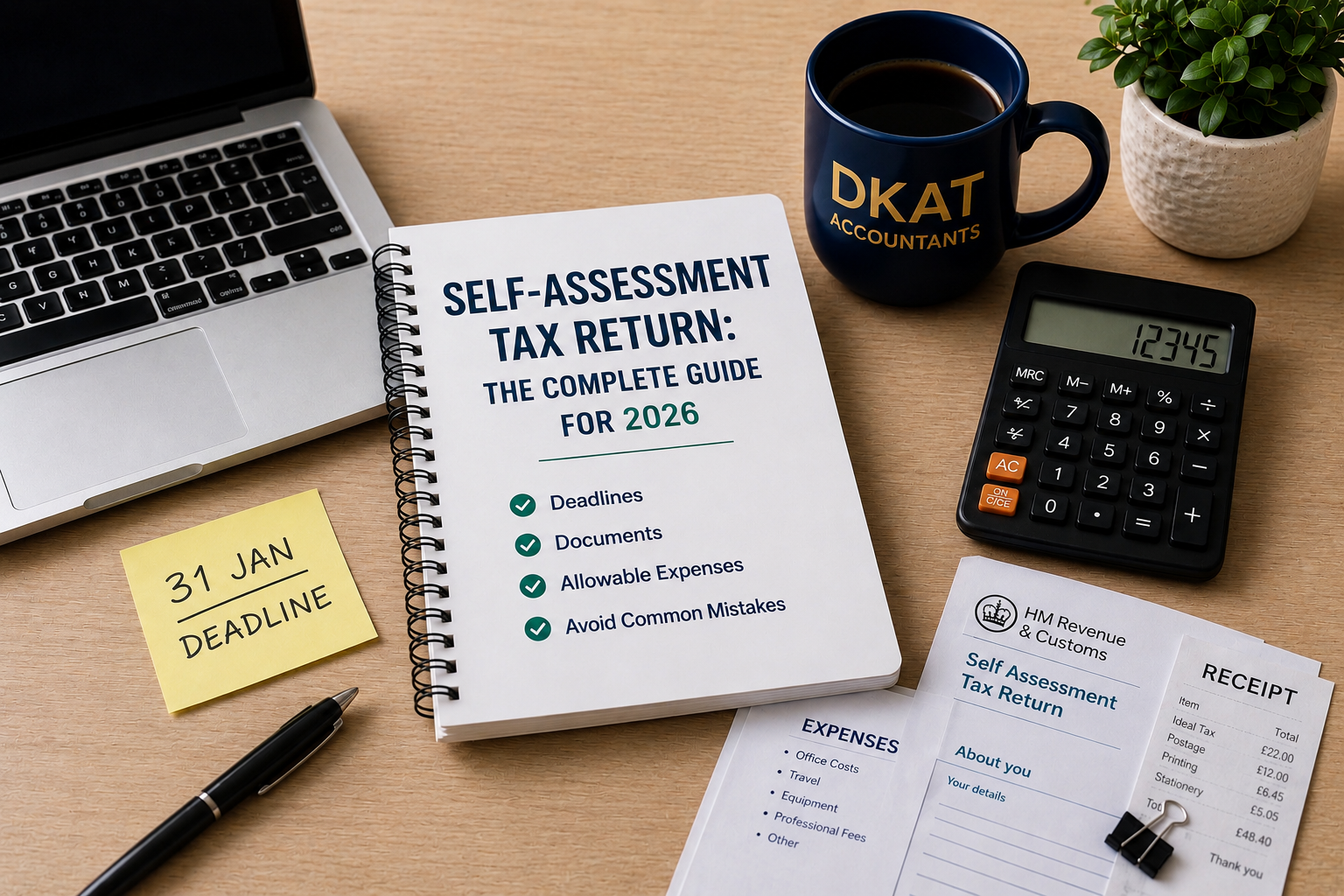
A Self Assessment tax return is how you report income to HMRC that is not automatically taxed through PAYE — covering self-employment, rental income, dividends, or income over £100,000. The key deadlines are 5 October to register if filing for the first time, 31 October for paper returns, and 31 January for online returns and full payment of tax owed. Missing the 31 January deadline triggers an automatic £100 penalty, even if no tax is due, with further penalties and interest accruing the longer the delay continues.
- Who needs to file a self-assessment return?
- Key deadlines for 2025/26 returns
- Documents and information you need to gather
- Allowable expenses: what you can and cannot claim
- Payments on account explained
- HMRC penalties for late filing and late payment
- The most common self-assessment mistakes
- MTD for Income Tax: what changes from April 2026
- How to register for self-assessment
- FAQ - Frequently asked questions
The 2025/26 self-assessment return covers income earned between 6 April 2025 and 5 April 2026. The online filing deadline is 31 January 2027, and any tax owed must be paid by the same date. Despite the seemingly distant deadline, the majority of errors, missed reliefs and unnecessary penalties arise from leaving everything to January.
This guide covers every stage of the self-assessment process — from confirming whether you need to file, to gathering the right documents, understanding what you can claim, and avoiding the mistakes that HMRC sees most often.
Who needs to file a self-assessment return?
HMRC requires you to file a self-assessment return if, in the 2025/26 tax year, any of the following applied to you:
- You were self-employed as a sole trader with gross income above £1,000 (the trading allowance)
- You are a partner in a business partnership
- You received rental income above £2,500 (or above £1,000 if you also have other untaxed income — if your rental income was between £1,000 and £2,500, contact HMRC)
- Your total taxable income exceeded £150,000 in the year
- You earned more than £100,000 from employment (PAYE alone cannot collect all the tax correctly at this level)
- You or your partner claimed Child Benefit and either of you earned more than £60,000
- You received untaxed income from savings, investments, or dividends exceeding your allowances
- You made capital gains above the annual exempt amount (£3,000 in 2025/26) from the sale of shares, property, or other assets
- You were a company director (unless the company is a non-profit and you receive no pay or benefits)
- You have foreign income to declare
- You claimed Gift Aid donations and are a higher or additional rate taxpayer wishing to claim the full relief
- HMRC has sent you a notice to file a return — if you receive this notice, you must file even if you believe you have no tax to pay
Key deadlines for 2025/26 returns
| Deadline | What it is |
|---|---|
| 5 October 2026 | Deadline to register for self-assessment if you are newly required to file a return for 2025/26. Miss this and HMRC may issue a penalty even before you file. |
| 31 October 2026 | Deadline for paper (postal) self-assessment returns for 2025/26. Paper filing is now uncommon but remains available. |
| 31 January 2027 | Deadline for online self-assessment returns for 2025/26 AND payment of any tax owed for 2025/26, including the first payment on account for 2026/27. |
| 31 July 2027 | Deadline for the second payment on account for 2026/27 (if payments on account apply to you). |
Documents and information you need to gather
The single biggest cause of delay and error in self-assessment is incomplete records. Gather the following before you start, or hand them to your accountant to work from:
For everyone
- Your Unique Taxpayer Reference (UTR) and National Insurance number
- P60 if employed (shows your total pay and tax deducted for the year — provided by your employer by 31 May 2026)
- P11D if your employer provided benefits in kind (company car, private medical insurance, etc.)
- P45 if you left employment during 2025/26
- Details of any State Pension or other taxable pension income
- Bank interest received — annual summary from each bank/building society
If self-employed
- Full income records — all invoices raised and payments received
- All business expense receipts and records (see Section 4 below)
- Mileage log if claiming business travel at the approved rate
- Details of any assets purchased or disposed of in the business
If you have rental income
- Total gross rent received from all properties
- All landlord expenses (see Section 4 below)
- Mortgage statements (for the finance cost restriction calculation under Section 24)
- Details of any improvements or replacements of domestic items
- If you sold a property: completion statement, original purchase costs, and costs of improvement
If you have investment income
- Dividend vouchers or statements from your broker or company
- Details of any shares, funds or other assets sold or disposed of in 2025/26
- Purchase costs and dates for any assets sold (needed for CGT calculation)
Other
- Gift Aid donations made during 2025/26 (retain receipts)
- Pension contributions made personally (not through payroll) — for higher-rate relief claims
- Any foreign income — rental, employment or investment income from abroad
- Any Student Loan repayment obligations (Plan 1, Plan 2, Plan 4 or Postgraduate)
Allowable expenses: what you can and cannot claim
Self-employed: allowable business expenses
You can deduct expenses that are incurred wholly and exclusively for the purposes of your trade. The most commonly claimed categories are:
- Office costs: stationery, postage, phone bills (business proportion), software subscriptions, accountancy software
- Travel: public transport costs for business journeys; mileage at HMRC approved rates (45p per mile for first 10,000 miles, 25p thereafter for cars); parking; accommodation for overnight business trips. Note: commuting between home and a regular place of work is not allowable.
- Clothing: only specialist protective clothing or uniforms with an employer logo. Ordinary clothing worn for business is not allowable even if you only wear it for work.
- Staff costs: salaries, employer NI, pension contributions, agency fees for subcontractors
- Marketing and professional fees: advertising, website costs, accountant fees, legal fees for business contracts
- Training: courses that update or maintain existing skills for your current trade. Training to enter a new trade is not allowable.
- Use of home: a reasonable proportion of household costs where you work from home. HMRC accepts £6 per week without requiring detailed records (the flat rate). For larger claims, you must calculate the actual proportion used for business.
- Capital equipment: claimed via the Annual Investment Allowance (100% in year of purchase up to £1m), not as a direct expense
Landlords: allowable rental expenses
You can deduct the following from rental income before calculating taxable profit:
- Letting agent fees and management charges
- Buildings and contents insurance
- Maintenance and repairs — restoring the property to its original condition. Note: improvements (adding something new) are capital expenditure, not a deductible expense.
- Council tax, utility bills, ground rent and service charges where paid by you (not the tenant)
- Accountancy and legal fees relating to the letting
- Replacement of domestic items (the Replacement of Domestic Items Relief) — the cost of replacing like-for-like furnishings in residential lettings. Initial purchases are not allowable; only replacements.
Mortgage interest: since the full phase-in of Section 24 from 2020/21, individual landlords can no longer deduct mortgage interest as a straight expense. Instead, you receive a 20% basic-rate tax credit on the finance costs. This means higher-rate and additional-rate taxpaying landlords now pay significantly more tax on mortgaged properties than before the restriction. Careful records of finance costs are still essential to claim the credit correctly.
Payments on account explained
Payments on account are advance payments towards your next year’s tax bill. HMRC requires them if your last self-assessment bill exceeded £1,000 AND less than 80% of your tax was collected at source (e.g., through PAYE). They apply to many self-employed individuals and landlords.
There are two payments on account each year:
- First payment: 31 January (same date as the balancing payment for the previous year) — equal to 50% of last year’s tax bill
- Second payment: 31 July — equal to a further 50%
If your income is lower in the current year than the year on which the payments are based, you can apply to reduce your payments on account using HMRC’s online service. However, if you reduce them and your actual bill is higher, you will pay interest on the shortfall. Do not reduce payments on account unless you are confident your income has fallen.
Example: If your 2024/25 tax bill was £6,000, HMRC requires you to pay £3,000 on 31 January 2026 (first payment on account for 2025/26) and £3,000 on 31 July 2026 (second payment). When you file your 2025/26 return by January 2027, any balancing payment or refund is calculated.
HMRC penalties for late filing and late payment
HMRC’s penalty regime for self-assessment is automatic and does not require any fault on your part. Understanding the penalties is the most effective motivation to file on time.
Late payment of tax owed also attracts interest at the HMRC late payment rate (currently HMRC base rate + 2.5%) from the due date, plus additional surcharges of 5% of unpaid tax at 30 days, 6 months and 12 months late.
You can appeal penalties if you have a reasonable excuse — serious illness, bereavement of a close relative, or an HMRC error. “I forgot” or “my accountant didn’t tell me” is generally not accepted. DKAT handles penalty appeals on behalf of clients where there are genuine grounds.
The most common self-assessment mistakes
- Missing income sources. HMRC receives data from banks, employers, benefits, the Land Registry and digital platforms. Any income that appears in their data but not in your return will trigger a query.
- Incorrect mileage claims. Using the wrong rate, claiming commuting miles, or not keeping a contemporaneous mileage log. HMRC expects a log showing date, journey purpose and distance.
- Forgetting payments on account. First-time self-assessment filers are often shocked that their January bill includes both the 2024/25 balancing payment and the first payment on account for 2025/26. Budget accordingly.
- Not claiming all reliefs. Gift Aid higher-rate relief, pension tax relief on personal contributions, marriage allowance, and blind person’s allowance are regularly missed.
- Wrong dividend amounts. Dividend income must be declared as the gross dividend, not the amount received net of any basic-rate credit (which no longer exists, but the confusion persists).
- Missing the 60-day CGT return on property. If you sold a residential property in 2025/26, you were required to report the gain and pay the tax within 60 days of completion. A separate annual self-assessment return does not replace this obligation.
- Not registering in time. If 2025/26 is the first year you needed to file, the deadline to notify HMRC was 5 October 2026. Late notification can itself attract a penalty.
MTD for Income Tax: what changes from April 2026
Making Tax Digital for Income Tax Self-Assessment is now live. From 6 April 2026, sole traders and landlords with combined gross income above £50,000 must use HMRC-approved software and submit four quarterly updates per year instead of a single annual return.
If you are in scope from April 2026, your 2025/26 return (covering the year just ended) is the last one you will file under the traditional self-assessment process. From 2026/27 onwards, your obligations change to quarterly reporting.
The quarterly deadlines are: 7 August, 7 November, 7 February and 7 May, followed by an End of Period Statement and a Final Declaration by 31 January. HMRC is applying a soft-landing penalty period during 2026/27, but quarterly submissions are still required. The threshold drops to £30,000 from April 2027 and £20,000 from April 2028.
How to register for self-assessment
If this is your first time filing, you need to register with HMRC before you can submit a return. The process depends on your circumstances:
- Self-employed: Register online via HMRC’s ‘Register as self-employed’ service. You will receive your UTR by post within 10 working days (longer during busy periods). You must also register for Class 4 National Insurance.
- Not self-employed (landlord, director, investor): Use HMRC’s online service to register for self-assessment, selecting the appropriate income type.
- Already registered in a previous year but did not file last year: Your UTR remains active. Log in to your HMRC online account and confirm that you still need to file.
Allow at least 20 working days from registration to receiving your UTR and activating your HMRC online account. If you are newly self-employed and started trading in 2025/26, the deadline to register was 5 October 2026.
FAQ Frequently asked questions
Sole traders, landlords with net rental income over £2,500, company directors receiving untaxed income, individuals earning over £100,000, and anyone with significant untaxed savings, dividend or overseas income typically need to register and file.
An automatic £100 penalty applies immediately, even if you owe no tax. Further penalties accrue at 3 months (£10/day up to £900), 6 months (5% of tax due or £300, whichever is greater), and 12 months (a further 5% or £300).
If your tax bill exceeds £1,000 and less than 80% of your tax is deducted at source, HMRC requires two advance "payments on account" toward next year's tax bill, due 31 January and 31 July, each equal to half of your previous year's liability.
Yes. You generally have until 12 months after the original filing deadline to amend an online Self Assessment return through your HMRC account, correcting errors or adding omitted information.
It is not a legal requirement, but for anyone with more than straightforward employment income, an accountant can ensure all allowable expenses and reliefs are claimed correctly, reducing both your tax bill and the risk of errors that could trigger an HMRC enquiry.
Let DKAT handle your 2025/26 self-assessment return
We prepare and file self-assessment returns for individuals, sole traders, landlords and company directors across London and the UK. Our service is fixed-fee, transparent and handled by FCCA-qualified accountants. We identify every allowable deduction, check your payments on account, and deal with HMRC directly if there are any queries. The process is straightforward and the peace of mind is worth considerably more than our fee.
Book Your Free Consultation →Important notice: This article covers the self-assessment return for the 2025/26 tax year (6 April 2025 to 5 April 2026) and is based on HMRC published guidance current at the date of writing (April 2026). All deadlines, thresholds and rules are subject to change. This article is for general information and educational purposes only and does not constitute tax, legal or financial advice. Individual circumstances vary and you should seek professional advice before relying on any information contained here. DKAT Accountants is regulated by the Association of Chartered Certified Accountants (ACCA).