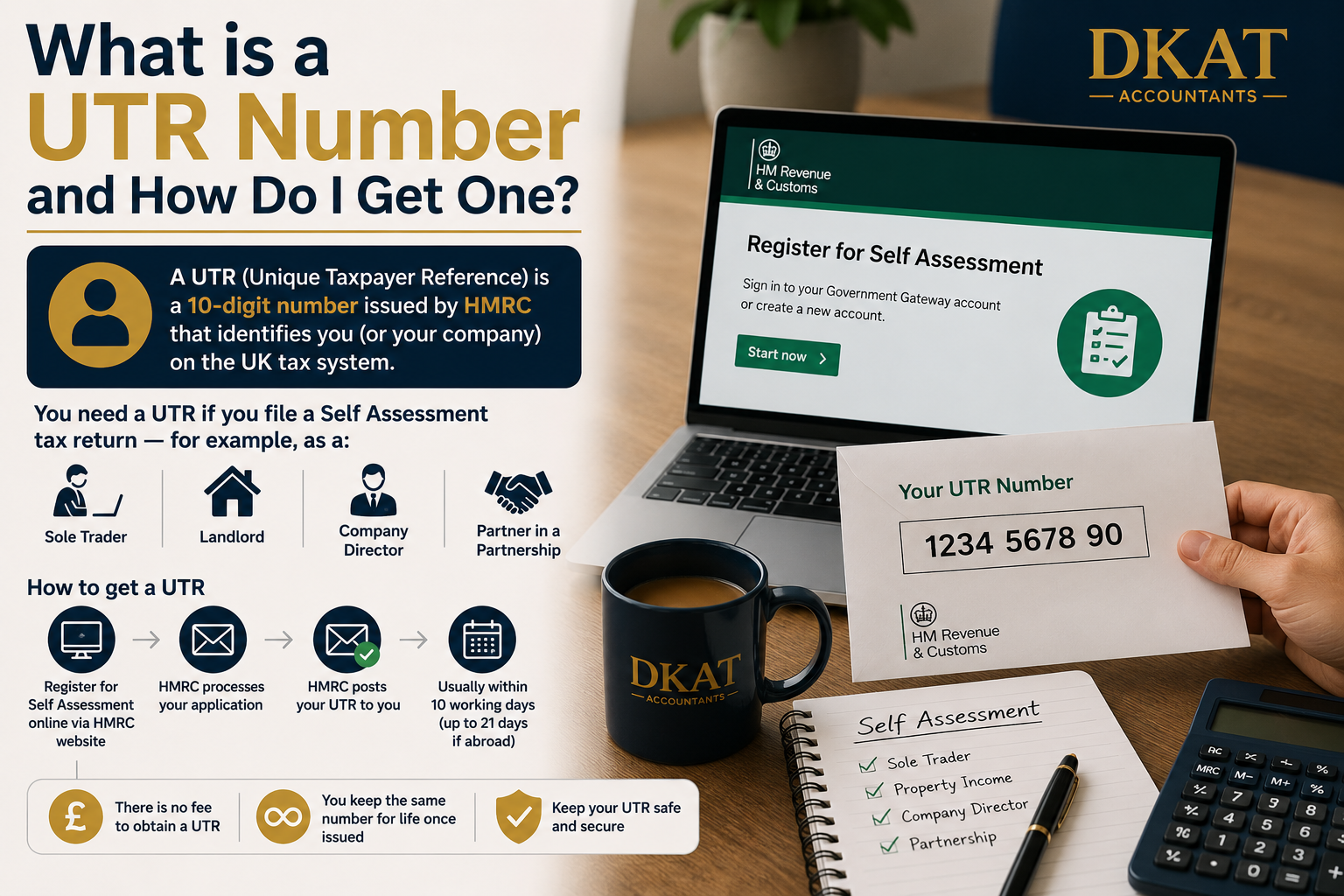
A UTR (Unique Taxpayer Reference) is a 10-digit number issued by HMRC that identifies you (or your company) on the UK tax system. You need one if you file a Self Assessment tax return — for example, as a sole trader, landlord, company director, or partner in a partnership. To get a UTR, you register for Self Assessment online via HMRC's website; HMRC then posts your UTR to you, usually within 10 working days (up to 21 days if you are abroad). There is no fee to obtain a UTR, and you keep the same number for life once issued.
- What exactly is a UTR number?
- Who needs a UTR?
- Personal UTR vs company UTR
- How to register and get your UTR — step by step
- How long does it take?
- Where to find your UTR if you already have one
- What happens if you miss the registration deadline?
- Common UTR problems and how to fix them
- Frequently asked questions
01 What exactly is a UTR number?
Your Unique Taxpayer Reference (UTR) is a 10-digit number that HMRC assigns to identify you as an individual taxpayer, or to identify a limited company, partnership or trust, within the UK tax system. It appears on Self Assessment tax returns, statements, payment reminders and most official HMRC correspondence relating to your tax affairs.
The requirement to register for Self Assessment and the mechanics of HMRC issuing a taxpayer reference derive from Taxes Management Act 1970, s.7 (the statutory duty to notify chargeability to tax) and s.8 (the requirement to deliver a return). The UTR itself is an administrative identifier HMRC uses to track that obligation, rather than something defined in a single named section of legislation — but the obligation to register that gives rise to it is a legal one, not a formality.
02 Who needs a UTR?
You need a UTR if you are required to file a Self Assessment tax return. Under HMRC's current criteria, this includes:
- Sole traders and self-employed individuals with trading income above the £1,000 trading allowance
- Partners in a business partnership (each partner needs their own UTR, and the partnership itself also has a UTR)
- Landlords with rental income above £2,500 net, or above £10,000 gross, in a tax year
- Company directors who receive income not fully taxed at source (dividends, benefits in kind, or income outside PAYE)
- Individuals with income above £100,000 (mandatory Self Assessment regardless of source)
- Anyone with untaxed income from savings, investments, or overseas sources above the reporting threshold
- Anyone who needs to claim certain reliefs (e.g. some pension tax relief claims) via Self Assessment
- Trustees of a trust that has tax to pay or report
Employees on PAYE generally don't need one. If your only income is employment income taxed through PAYE and you meet none of the criteria above, you typically will not need to register for Self Assessment or obtain a UTR. HMRC's online tool ("Check if you need to send a Self Assessment tax return") can confirm your specific position.
03 Personal UTR vs company UTR
It's a common point of confusion: individuals and limited companies each have their own separate UTR, and a company director will typically hold both.
| UTR type | Issued to | Used for |
|---|---|---|
| Personal UTR | An individual | Self Assessment tax return (SA100), personal tax affairs |
| Company UTR | A limited company (on incorporation) | Corporation Tax return (CT600) |
| Partnership UTR | The partnership itself | Partnership tax return (SA800), separate from each partner's own UTR |
A company's UTR is issued automatically by HMRC shortly after Companies House confirms incorporation — you do not need to separately apply for it. It typically arrives by post at the company's registered office within a few weeks of formation.
04 How to register and get your UTR — step by step
Confirm you need to register
Check whether your circumstances require Self Assessment registration using HMRC's online eligibility checker, or based on the criteria in Section 2 above.
Register online with HMRC
Go to the official GOV.UK Self Assessment registration service. The exact form depends on your situation: form SA1 for most individuals not self-employed (e.g. company directors, landlords), or registering as self-employed via the dedicated route if you're a sole trader (this also sets up your Class 2 National Insurance position).
Provide your details
You'll need your full name, date of birth, National Insurance number, address, contact details, and information about the income or activity that triggers the registration requirement (e.g. self-employment start date).
Wait for HMRC to post your UTR
HMRC sends your UTR by post to the address provided — it is not emailed or displayed instantly online, for security reasons. Keep this letter safe; you'll need the UTR every year going forward.
Activate your online account
Once you have your UTR, you'll also receive an activation code to set up your Government Gateway account, allowing you to file returns online each year.
05 How long does it take?
| Scenario | Typical timeframe |
|---|---|
| Standard registration, UK address | Up to 10 working days |
| Registration while living abroad | Up to 21 working days |
| New limited company (automatic) | A few weeks after incorporation |
Don't leave registration until the last minute. The deadline to register for Self Assessment for the first time is 5 October following the end of the tax year in which you need to start filing. If you register close to this date and your UTR takes 10+ working days to arrive, you may find yourself very close to the 31 January filing and payment deadline with limited time to prepare your return properly.
06 Where to find your UTR if you already have one
If you've registered before but have lost or misplaced your UTR, you can find it on:
- Your original UTR registration letter from HMRC
- Previous Self Assessment tax returns (SA100) you or your accountant have filed
- Any "Notice to complete a tax return" (SA316) letters from HMRC
- Statements of account or payment reminders from HMRC
- Your HMRC online Personal Tax Account (log in via Government Gateway)
- Your HMRC app, under "Self Assessment"
If none of these are available, you can call the HMRC Self Assessment helpline; they will typically post your UTR to your registered address as a security measure — they generally cannot read it out over the phone or send it by email.
07 What happens if you miss the registration deadline?
Missing the 5 October registration deadline (the "notification deadline" under TMA 1970, s.7) can result in a failure to notify penalty, calculated as a percentage of the tax that should have been paid on time, even if you go on to file and pay everything correctly once registered. The penalty percentage depends on whether the failure was non-deliberate or deliberate, and whether the disclosure was prompted or unprompted by HMRC:
| Behaviour | Unprompted disclosure | Prompted disclosure |
|---|---|---|
| Non-deliberate | 0% – 30% | 10% – 30% |
| Deliberate | 20% – 70% | 35% – 70% |
| Deliberate and concealed | 30% – 100% | 50% – 100% |
In practice, if you register late but with no tax outstanding at the time (for example, because you had no profit in your first year), the penalty may be reduced to nil, but you should still register as soon as you realise the obligation applies — delaying further only increases risk.
08 Common UTR problems and how to fix them
- "I've registered twice and now have two UTRs" — this can happen if you register again without checking for an existing UTR. Contact HMRC to have the duplicate merged or cancelled; do not simply use whichever one you prefer, as this can cause reconciliation issues.
- "My UTR letter never arrived" — check the address you registered wasn't entered incorrectly. If it's genuinely lost in the post, contact HMRC after the expected 10/21-day window; they can arrange a reissue, again by post.
- "I need my UTR urgently to submit a mortgage application" — lenders often want SA302 tax calculations and tax year overviews, both of which reference your UTR. If you can't locate the physical letter, your HMRC online account or accountant can usually retrieve these documents faster than requesting a fresh UTR letter.
- "I'm a new company director and don't know if I need a personal UTR" — being a director alone does not automatically require Self Assessment, but receiving dividends, benefits in kind, or other untaxed income usually does. Check your specific position rather than assuming either way.
09 Frequently asked questions
No. Your National Insurance number (format: two letters, six digits, one letter — e.g. QQ123456C) identifies you for National Insurance contributions and state benefits, and is issued automatically around age 16. Your UTR is a separate 10-digit number specifically for tax reporting via Self Assessment or Corporation Tax, and is only issued when you register for one of those regimes.
No. A UTR is issued once and remains yours for life (for a personal UTR) or for the life of the company (for a company UTR). You do not need to reapply each year — you simply continue using the same number on each year's return.
No. HMRC does not issue UTRs instantly; they are posted, which takes up to 10 working days (21 if abroad), as a security control to reduce fraud. If you need proof of your tax position urgently for something like a mortgage application, ask your accountant whether an SA302 or tax year overview from an existing UTR would meet the requirement instead of requesting a brand new registration.
If your gross trading income from self-employment or a side hustle is below the £1,000 trading allowance in a tax year, you generally do not need to register or report it. Above £1,000, you normally need to register for Self Assessment and will be issued a UTR as part of that process.
You should tell HMRC you've stopped trading (there's a specific online process to deregister from Self Assessment where trading has ceased and no other Self Assessment criteria apply). Your UTR itself doesn't disappear, but you may no longer be required to file returns each year once HMRC confirms your circumstances no longer require it.
Need help registering for Self Assessment?
DKAT Accountants handles the entire Self Assessment registration process for you — from confirming whether you actually need to register, to completing the correct HMRC form, to filing your return once your UTR arrives. All on a fixed fee.
Book a Free Consultation →