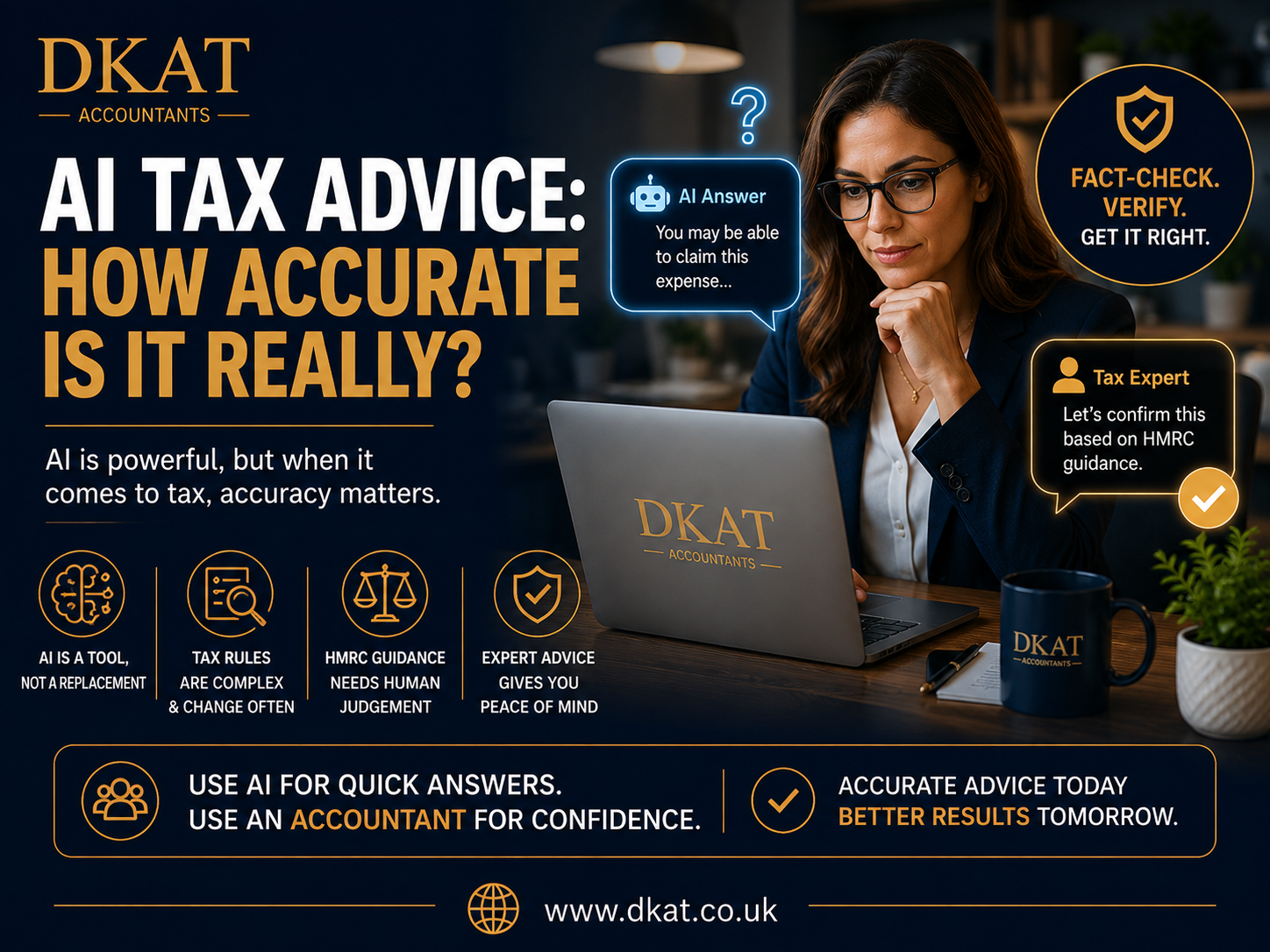
AI chatbots can and do get UK tax advice wrong — even the UK government's own official chatbot, GOV.UK Chat, gave incorrect answers within hours of its May 2026 launch, despite a claimed 90% accuracy rate. Independent testing found it wrongly stated there was no upper income limit for Tax-Free Childcare (there is — eligibility disappears entirely above £100,000) and gave confused guidance on whether selling a personal MacBook could trigger Capital Gains Tax. Crucially, you remain fully responsible for your own tax position even if an AI tool gives you wrong information — HMRC's "reasonable care" test still applies, and relying solely on a chatbot is unlikely to be accepted as a valid excuse for penalties or an incorrect return.
- The real example: the UK government's own AI got it wrong
- Mistake 1 — the £100,000 childcare cliff edge
- Mistake 2 — confusing a MacBook sale with Capital Gains Tax
- Why AI gets tax questions wrong
- The legal reality: you're still liable
- When AI is actually useful for tax questions
- How to fact-check an AI tax answer yourself
- Frequently asked questions
AI chatbots now answer millions of tax questions a day, from casual ChatGPT queries to official government tools. They're confident, fast, and written in plain English — which is exactly what makes them dangerous when they're wrong. This article walks through a real, well-documented case of AI tax advice failing publicly, explains why it happened, and sets out exactly where the legal responsibility lands when it does — on you, not the AI.
01 The real example: the UK government's own AI got it wrong
On Friday 15 May 2026, the UK government launched GOV.UK Chat inside the GOV.UK app, described by ministers as the most comprehensive government-built chat tool in the world. It draws answers from roughly 80,000 pages of official GOV.UK guidance and was, according to the Technology Secretary, "tested to destruction" before launch, with an internal accuracy rate of around 90%.
Within hours, tax barrister Dan Neidle, founder of the transparency campaign group Tax Policy Associates, published test results showing the chatbot had given misleading answers to two ordinary, realistic tax questions. This wasn't an obscure edge case or an adversarial "jailbreak" attempt — it was the kind of question thousands of real taxpayers ask every week.
02 Mistake 1 — the £100,000 childcare cliff edge
This particular error is especially significant because the £100,000 threshold is the same figure that triggers the personal allowance taper (sometimes called the "60% tax trap") and several other cliff-edge benefit withdrawals. Anyone planning a pay rise, bonus, or self-employed income near this exact number needs precise advice — not a confident-sounding answer that misses the single most important rule in play.
03 Mistake 2 — confusing a MacBook sale with Capital Gains Tax
Neither of these questions was designed to trick the system. They're the kind of thing a parent weighing up a pay rise, or someone clearing out an old laptop, would type into a search bar without a second thought — which is exactly the population most likely to trust the answer at face value.
04 Why AI gets tax questions wrong
- Confident, fluent wrong answers look identical to confident, fluent right answers. AI models are optimised to sound authoritative regardless of whether the underlying content is accurate — there's no built-in "uncertainty flag" a reader can see.
- Rules with cliff edges and thresholds are exactly where general-purpose AI struggles most. A model can correctly summarise the general shape of a scheme while missing the one specific number (like the £100,000 childcare cliff edge) that actually determines the outcome.
- Jurisdictional confusion is common. Much AI training data is US-weighted. A UK-specific test like HMRC's "wholly and exclusively" rule for business expenses is subtly different from the US "ordinary and necessary" standard — and a model can apply the wrong one without any obvious sign it's done so.
- Tax rules change every year, and training data goes stale. Rates, thresholds and allowances shift at every Budget and tax year-end; a model trained on older data can confidently quote a superseded figure.
- Even a well-resourced, official government tool isn't immune. GOV.UK Chat was built specifically for this purpose, trained on curated official guidance, and still shipped with roughly a 1-in-10 error rate on launch day.
05 The legal reality: you're still liable
HMRC will not accept "the AI told me so" as a valid excuse. If you act on incorrect AI-generated advice and it results in an underpayment, an incorrect return, or a missed deadline, you remain fully responsible for the tax owed and can face interest and penalties on top — regardless of which chatbot gave you the wrong answer, official or otherwise.
HMRC's penalty framework is built around a "reasonable care" test: did you take reasonable steps to get your tax right? Legal precedent (including the Court of Appeal's ruling in the Aozora case) sets a high bar for arguing that reliance on official guidance should excuse an incorrect outcome — broadly, it must have been reasonable to rely on that guidance, and enforcing the correct legal position would have to be so unfair as to amount to an abuse of power. Chatbot tools that repeatedly direct users back to the underlying official guidance and ask them to confirm they understand the tool's limitations (as GOV.UK Chat does) make that argument even harder to sustain — you were told, in effect, to double-check.
In short: whether the source of the wrong answer is a general-purpose chatbot like ChatGPT or the UK government's own official tool, the financial and legal consequences of an incorrect tax position land on you, the taxpayer, not the AI provider.
06 When AI is actually useful for tax questions
| Use case | Is AI a reasonable starting point? |
|---|---|
| Explaining a general tax concept in plain English | Yes — good for building understanding |
| Finding which HMRC form or guidance page you need | Yes — useful as a search shortcut |
| Calculating your exact tax liability | No — verify with a professional or HMRC's own calculators |
| Any question near a threshold or cliff edge (£50,270, £100,000, £125,140) | No — this is exactly where AI most often fails |
| Cross-border, business, or non-standard situations | No — too much nuance for a general-purpose model |
| Anything you plan to act on financially | No — confirm with a qualified accountant first |
07 How to fact-check an AI tax answer yourself
- Cross-check any specific number, rate or threshold directly against current GOV.UK guidance before relying on it
- Be especially sceptical of answers involving round-number thresholds — £50,270, £90,000, £100,000, £125,140 — since these are precisely where cliff-edge rules live
- Ask the AI to cite its source, then actually check that source says what the AI claims it says
- Remember that even official, purpose-built government AI tools have a documented error rate — treat any single AI answer as a starting point, not a conclusion
- For anything involving real money — a return you're about to file, a decision about income timing, a property sale — get it confirmed by a qualified accountant before acting
08 Frequently asked questions
The specific errors identified at launch were publicly reported and the government has said it continues refining the tool. As with any AI system, isolated errors being fixed doesn't guarantee the underlying failure mode — missing cliff-edge rules or subtle distinctions — won't recur elsewhere. Always verify significant answers independently.
It's legally very difficult. HMRC can only be bound by its own incorrect guidance in narrow circumstances — broadly, where it was clear, unconditional, reasonable to rely on, and enforcing the correct position would be genuinely unfair. Since GOV.UK Chat explicitly tells users to verify answers against official guidance, this defence is unlikely to succeed in practice.
Not necessarily better or worse — both are general-purpose or semi-general tools without professional accountability. General AI chatbots like ChatGPT, Copilot and Gemini have also been documented giving UK consumers incorrect financial guidance, including advice that could breach ISA contribution limits. The common thread is the absence of professional duty of care, not the specific brand of AI.
There's a meaningful difference between AI helping draft or research general educational content that is then reviewed against current legislation, and relying on an unsupervised AI chatbot for a specific, personal tax calculation or filing decision. DKAT's published guidance reflects FCCA-qualified oversight; a live chatbot answer to your specific numbers does not have that safeguard.
Use it to understand concepts and terminology, and to find the right official guidance page faster — then verify anything specific to your numbers or circumstances against that official source, or with a qualified accountant, before you file or act on it.
Don't let an AI chatbot decide your tax position
DKAT Accountants gives you FCCA-qualified, professionally accountable advice — not a plausible-sounding guess. Get a second opinion on anything an AI tool has told you, before you file or act on it.
Book a Free Consultation →