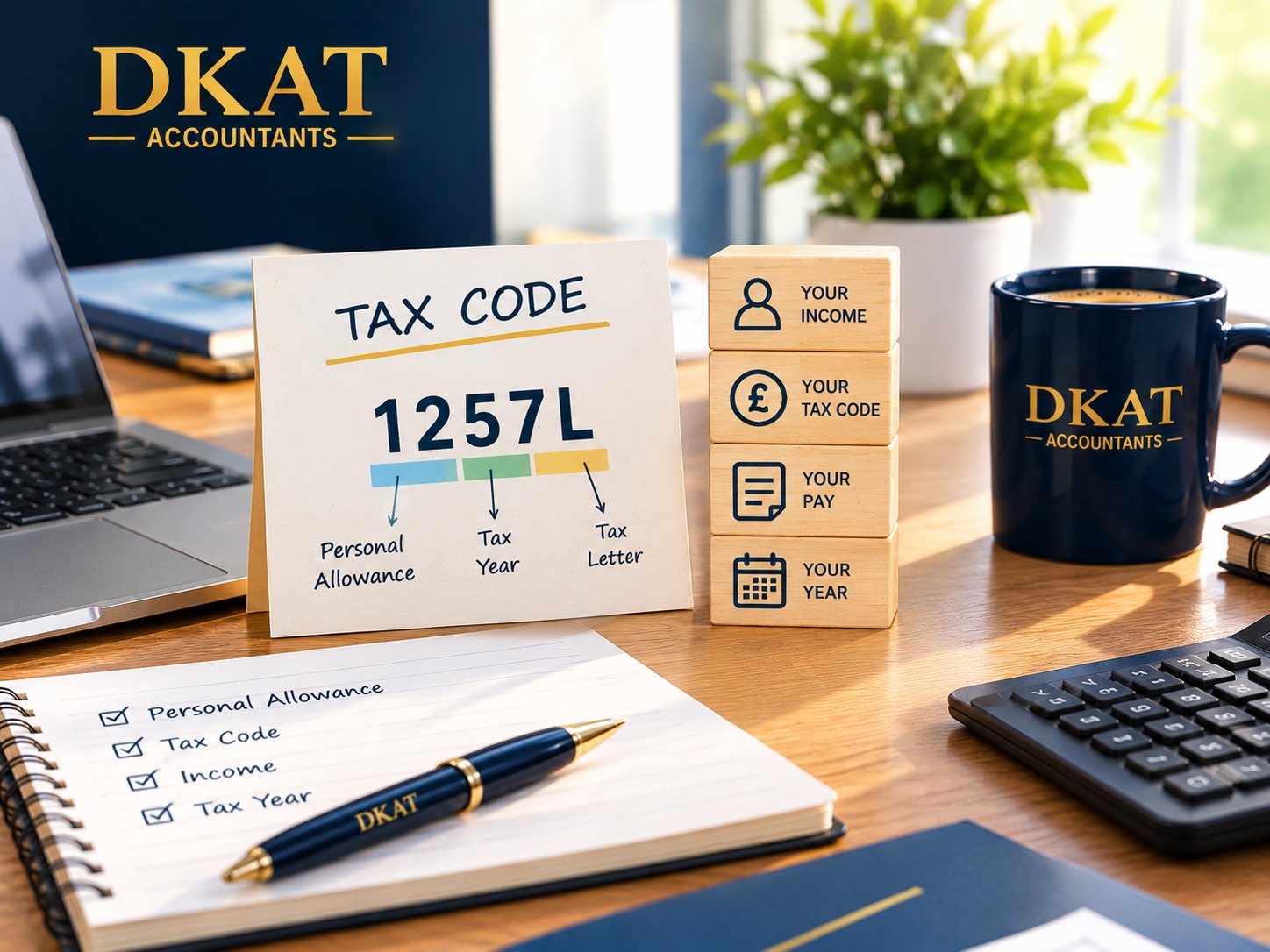
Check your tax code on your payslip, your P60 or P45, or in your HMRC personal tax account (use “Check your Income Tax for the current year”). The standard code for 2026/27 is 1257L: the number times ten is your tax-free personal allowance (£12,570), and the letter shows which allowance applies. BR taxes all your pay at 20%, 0T gives you no allowance, D0 taxes at 40%, a K code adds untaxed income to your pay, and W1, M1 or X marks a temporary emergency basis. If you have one job and no benefits and your code isn’t 1257L, check why. Only HMRC can change it, not your employer.
Most payslip surprises trace back to one line: the tax code. It tells your employer how much of your pay to treat as tax-free, and a wrong one can cost you hundreds of pounds before anyone notices. Your employer doesn’t pick it. HMRC issues it, and your payroll applies it.
01 How to read a tax code
A code has two parts: a number and a letter. The number, multiplied by ten, gives the amount of income you can earn tax-free in the year. The letter says which rule applies.
1257L is the code most employees see for 2026/27. Spread across a monthly payslip, it shields £1,047.50 of your pay from tax each month. These are the other codes you are likely to meet.
| Code | What it does | When you usually see it |
|---|---|---|
| 1257L | Full £12,570 allowance | One job, no adjustments |
| BR | No allowance; all pay taxed at 20% | Second job or second pension |
| D0 | No allowance; all pay taxed at 40% | Second job where income is in the higher-rate band |
| 0T | No allowance; normal bands apply | New job without a P45, or allowance already used up |
| K code (e.g. K250) | Adds income to your pay before tax | Taxable benefits or untaxed income exceed your allowance |
| M or N suffix | Marriage Allowance received or given | Couples who have transferred allowance |
| NT | No tax deducted | Rare special cases |
| W1, M1 or X | Emergency basis; each pay period taxed on its own | HMRC lacks full details |
| S or C prefix | Scottish or Welsh rates apply | Taxpayers resident in Scotland or Wales |
02 Where to find your tax code
Your payslip
The fastest check. The code is printed alongside your pay and deductions, usually under a heading like “Tax Code”.
Your P60 or P45
Your P60 shows your code at the end of the tax year, and your P45 shows it when you leave a job. Compare it with what you are on now.
HMRC personal tax account or the HMRC app
Log in and use “Check your Income Tax for the current year”. It shows the code HMRC holds for each job or pension, how it was worked out, and lets you update your details.
A P2 coding notice
HMRC posts this when your code changes. It lists every item behind the new figure. Keep it; it’s the evidence if you need to challenge the code.
03 Worked example: a second job coded wrongly
Both jobs claim the same £12,570 allowance, so Elena’s second employer deducts nothing from £8,000 of pay. HMRC will spot the gap and recover it later, either through a lower allowance next year or a bill after the year ends. Coding the second job BR would have taken £1,600 (20% of £8,000) as she earned it. If you start a second job, tell HMRC so the allowance is shared out correctly.
04 Worked example: a new starter on an emergency code
Josh didn’t hand over a P45 or complete the starter checklist, so payroll had no information and used 0T. The overpayment isn’t lost. Once HMRC has his details and issues the right code, the excess comes back through his payslip. He can speed that up by giving his employer the missing details straight away.
05 K codes and Marriage Allowance codes
A K code looks odd because it works in reverse. It’s used when the value of taxable benefits, or untaxed income HMRC is collecting through your pay, is bigger than your allowance. Instead of reducing your taxable pay, it adds to it. A code of K250 adds roughly £2,500 to your taxable pay, so a basic-rate taxpayer pays about £500 more across the year than on 0T. HMRC limits the tax taken through a K code to half your pay in any period.
M and N codes relate to Marriage Allowance. A partner receiving the transfer sees 1383M (£12,570 plus £1,260), and the partner giving it up sees 1131N (£12,570 minus £1,260). If you have claimed Marriage Allowance and your code doesn’t show the letter, the claim hasn’t reached your payroll.
06 How to get a wrong code fixed
- Update your details in your HMRC personal tax account: second jobs, benefits, estimated income, Marriage Allowance
- Or phone HMRC with your National Insurance number and your latest payslip to hand
- HMRC then issues the corrected code to your employer, who applies it from the next pay run they can
- Any overpaid tax comes back through payroll or as a refund. Underpaid tax is collected through a later code or a bill
- If you file Self Assessment, check the code details on your return too, since they feed into the final calculation
Don’t ask your employer to change the code. They can’t. Payroll must use the code HMRC supplies, so contacting HMRC directly is the only route that works.
07 Frequently asked questions
No. It’s correct only if you have one job or pension, no taxable benefits, and no tax owed from earlier years. A second income, a company car, private medical insurance or underpaid tax will normally change it, so the code on your payslip may be right even when it isn’t 1257L.
Common triggers are a pay rise, a new taxable benefit, a second job or pension, a claim for Marriage Allowance or work expenses, and HMRC collecting tax underpaid in a previous year. HMRC also updates codes when a new tax year starts. Your P2 coding notice lists each item behind the change.
Usually the higher-paying job, with the second job coded BR so all of its pay is taxed at 20%, or D0 at 40% where it falls in the higher-rate band. You can ask HMRC to split the allowance between the two if that suits your pay pattern better.
Until HMRC receives your details and issues a permanent code. That is often within a few pay periods, but it depends on how quickly the information reaches HMRC. Giving your employer a P45 or a completed starter checklist is the quickest way to end it.
Yes. Once the code is corrected, HMRC adjusts your tax through payroll or sends a refund. For earlier years, you can ask HMRC to review your tax position for up to four previous tax years, provided the overpayment can be shown.
Not sure your code is right?
DKAT Accountants reads your payslip and P2 notice, finds what is driving the code, and gets HMRC to correct it, including any refund you are owed.
Book a Free Consultation →