Before hiring an accountant in London, check: 1) they hold a recognised qualification (ACCA, ICAEW or CIMA) and the firm itself is regulated by one of these bodies; 2) they carry professional indemnity insurance; 3) they offer fixed, transparent fees rather than open-ended hourly billing; 4) they have direct experience with your industry or business type; 5) they use Making Tax Digital-compatible software such as Xero or QuickBooks; 6) they are proactive, not just reactive at filing deadlines; and 7) you can get genuine client reviews or references. A properly regulated, FCCA or ACCA-qualified accountant should satisfy all seven without hesitation.
- Check 1 — Qualifications: ACCA, ICAEW or CIMA
- Check 2 — Is the firm actually regulated?
- Check 3 — Professional indemnity insurance
- Check 4 — Fixed fees vs hourly billing
- Check 5 — Relevant industry experience
- Check 6 — Making Tax Digital software
- Check 7 — Proactive advice, not just compliance
- Red flags to watch for
- Frequently asked questions
Choosing the wrong accountant costs more than a bad hourly rate. It can mean missed HMRC deadlines, penalties, tax reliefs left unclaimed, or advice that is technically legal but poorly suited to your situation. With thousands of accountants and bookkeeping services operating across London, ranging from major firms to informal "tax return only" services, knowing what to actually check before signing up is the difference between a long-term asset to your business and a costly mistake.
Here are the seven things worth verifying before you commit to any accountant in London.
01 Check 1 — Qualifications: ACCA, ICAEW or CIMA
Look for a recognised professional qualification
In the UK, "accountant" is not a legally protected title — technically, anyone can call themselves an accountant with no formal training at all. What is protected and meaningful is membership of a chartered body: ACCA (Association of Chartered Certified Accountants), ICAEW (Institute of Chartered Accountants in England and Wales), or CIMA (Chartered Institute of Management Accountants). An FCCA designation (Fellow of ACCA) indicates a senior, experienced practitioner who has held ACCA membership for a set number of years and met continuing professional development requirements.
How to verify: Ask directly which body the accountant is a member of, and their membership number. ACCA and ICAEW both offer free public "find a member" or "find a firm" search tools on their websites, letting you confirm a qualification claim in under a minute.
02 Check 2 — Is the firm actually regulated?
An individual holding a qualification is not the same as the firm being properly regulated. In the UK, firms offering accountancy and tax services should be supervised for anti-money laundering (AML) purposes under the Money Laundering, Terrorist Financing and Transfer of Funds Regulations 2017, either directly by HMRC or through their chartered body (ACCA and ICAEW both act as AML supervisors for their regulated firms).
A properly regulated firm will also be bound by a professional code of ethics and subject to a formal complaints and disciplinary process if something goes wrong — protections you do not get from an unregulated bookkeeper or "accountant" operating outside any supervisory body.
- Ask which body supervises the firm for AML purposes
- Check the firm's registration status is current, not lapsed
- Confirm there is a formal complaints procedure you could use if needed
03 Check 3 — Professional indemnity insurance
Confirm they carry adequate PI cover
Professional indemnity (PI) insurance protects you if the accountant makes an error that costs you money — for example, a missed deadline resulting in a penalty, or incorrect advice that triggers an HMRC investigation. Chartered bodies such as ACCA and ICAEW require member firms to hold PI insurance meeting a minimum level appropriate to the size and risk profile of their client base, as a condition of membership.
An accountant unwilling to confirm they hold PI insurance, or unable to state roughly what level of cover they carry, is a meaningful warning sign — particularly for a business handling significant sums or complex tax positions.
04 Check 4 — Fixed fees vs hourly billing
Fee structures vary widely across London accountancy firms. Understanding which model you are being offered, and its implications, matters before you sign an engagement letter.
| Fee model | How it works | What to watch for |
|---|---|---|
| Fixed annual/monthly fee | Agreed price for defined scope of work, known in advance | Confirm exactly what's included — e.g. does it cover HMRC correspondence, or is that billed separately? |
| Hourly rate | Billed per hour worked, invoice varies month to month | Ask for an estimated range upfront; unclear scope can lead to unexpectedly large bills |
| Per-service pricing | Separate charge for each task (return, payroll run, VAT return, etc.) | Costs can add up quickly if you need frequent ad-hoc support |
For most small businesses, sole traders and individuals, a fixed fee agreed in advance — covering a clearly defined scope — offers the most predictable and transparent arrangement, and avoids the anxiety of an open-ended hourly clock running every time you send a question by email.
05 Check 5 — Relevant industry experience
Ask whether they've worked with businesses like yours
Tax and accounting rules that matter enormously to a construction contractor (CIS, subcontractor verification) are largely irrelevant to a SaaS startup (R&D tax credits, EMI share schemes), which in turn differ from a landlord's priorities (Section 24 mortgage interest restrictions, CGT on disposal). An accountant with genuine experience in your specific sector or business structure will spot planning opportunities and pitfalls a generalist might miss entirely.
Ask directly: "How many clients do you currently have in [your industry/situation]?" A confident, specific answer with examples is a good sign. A vague answer, or one that pivots quickly to a different topic, suggests the experience may not be there.
06 Check 6 — Making Tax Digital software
Since April 2022, Making Tax Digital (MTD) for VAT has been mandatory for all VAT-registered businesses, and MTD for Income Tax (MTD ITSA) became mandatory from April 2026 for sole traders and landlords with qualifying income above £50,000. A competent modern accountant should already be working comfortably within MTD-compatible software such as Xero, QuickBooks, FreeAgent, Sage or QuickFile — not manually re-typing figures from paper records or basic spreadsheets into HMRC's portal.
Ask specifically: "Which accounting software do you use, and is it MTD-compliant?" If an accountant seems unfamiliar with MTD requirements, or still relies primarily on paper records and manual HMRC submissions, this suggests they may not be keeping pace with current compliance obligations — a real risk given the penalty regime attached to MTD failures.
07 Check 7 — Proactive advice, not just compliance
There is a meaningful difference between an accountant who simply files your return each year (reactive, compliance-only) and one who actively flags opportunities and risks throughout the year (proactive, advisory). Signs of a genuinely proactive accountant include:
- They contact you before deadlines, not just after you've missed one
- They ask about upcoming plans (buying property, hiring staff, taking on investment) to flag tax implications in advance
- They suggest specific reliefs or planning opportunities relevant to your situation, unprompted
- They review your position periodically, not just once a year at filing time
- They explain their reasoning in plain English, rather than jargon-heavy responses that leave you no clearer
08 Red flags to watch for
- Guaranteed refunds or unusually large savings promised upfront — before they've reviewed any of your actual figures, this is a serious warning sign of aggressive or non-compliant advice
- Reluctance to put fees in writing — a proper engagement letter setting out scope and cost is standard practice for any regulated firm
- No verifiable qualification or firm registration — if you cannot confirm ACCA, ICAEW or CIMA membership independently, treat this as disqualifying for anything beyond the simplest bookkeeping task
- Poor or slow communication during the sales process — if getting a straight answer is difficult before you're even a client, it rarely improves afterward
- No mention of AML checks — regulated firms are legally required to carry out identity verification (know-your-client) checks before taking you on; a firm that skips this entirely may not be properly supervised
09 Frequently asked questions
Yes, technically. "Accountant" is not a protected title in the UK, unlike "chartered accountant" or "chartered certified accountant," which are protected and can only be used by qualified members of bodies like ICAEW or ACCA. This is exactly why checking for a recognised qualification matters so much when choosing who to trust with your finances.
All three are recognised chartered accountancy bodies with rigorous qualification standards, AML supervision, and codes of ethics. ACCA and ICAEW members commonly work in general practice, tax and audit, while CIMA has a stronger focus on management accounting within businesses. For general small business and personal tax needs, ACCA and ICAEW-qualified firms are the most common choice.
Remote working with cloud accounting software (Xero, QuickBooks) means location matters far less than it once did. Many well-regarded firms serve clients across the whole UK without requiring in-person meetings. What matters more is responsiveness, communication style, and relevant experience — a highly-rated firm slightly further away is usually a better choice than a mediocre one nearby purely for convenience.
Costs vary significantly by business complexity, turnover and scope of services. A simple personal Self Assessment return might cost a few hundred pounds annually, while a limited company with payroll, VAT and full bookkeeping could run into several thousand pounds a year. Always ask for a fixed quote based on your specific circumstances rather than relying on generic published price lists.
Yes, switching is straightforward and common. Your new accountant will typically send a professional clearance request to your existing accountant, and once any outstanding fees are settled, your records and HMRC authorisation are transferred. There is no need to wait for a specific point in the tax year to make the change.
Looking for an FCCA-qualified accountant in London?
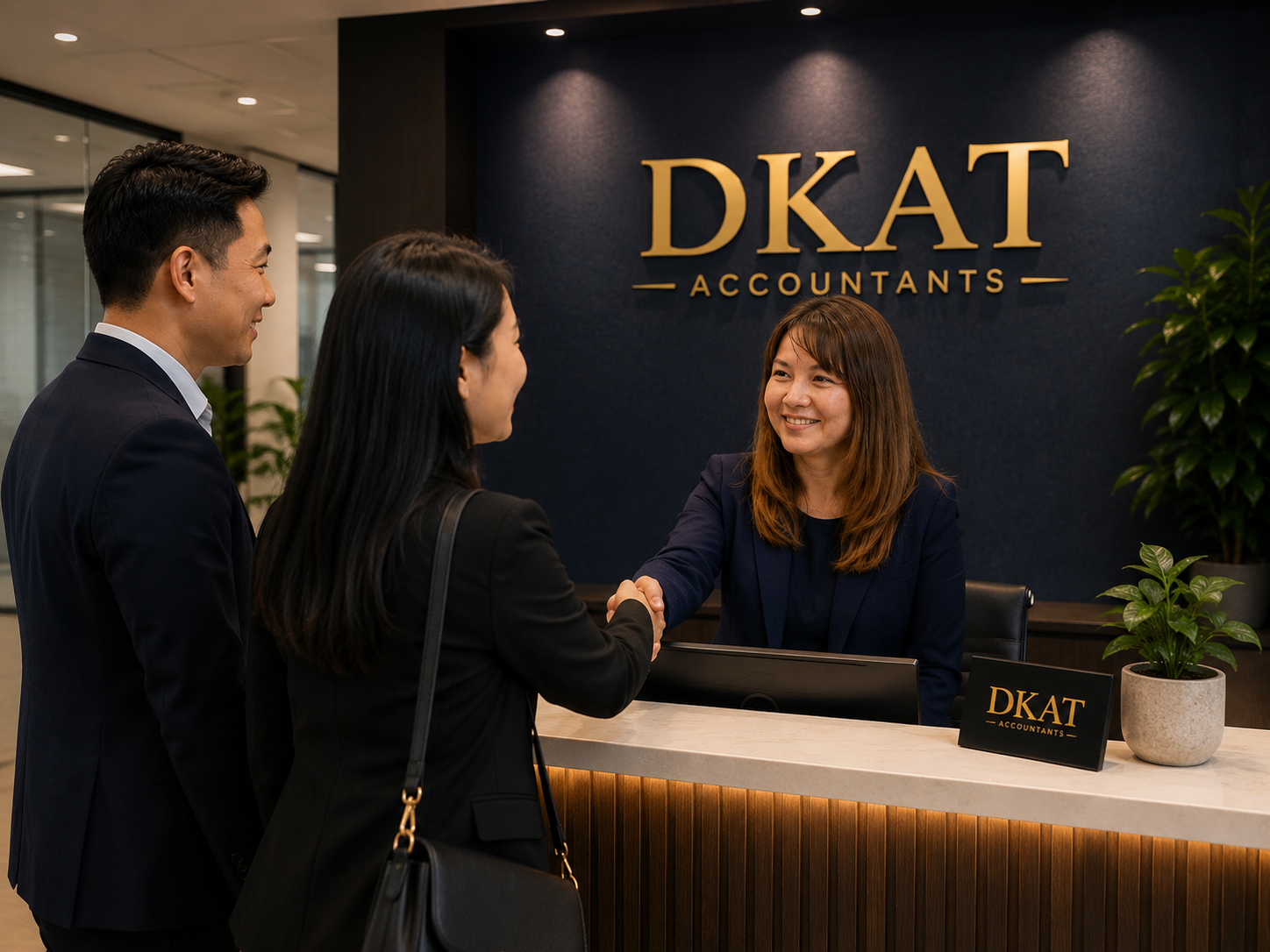
DKAT Accountants ticks all seven boxes above: FCCA-qualified, ACCA-regulated, fully insured, fixed transparent fees, MTD-compliant software, and proactive advice throughout the year — not just at deadline time.
Book a Free Consultation →