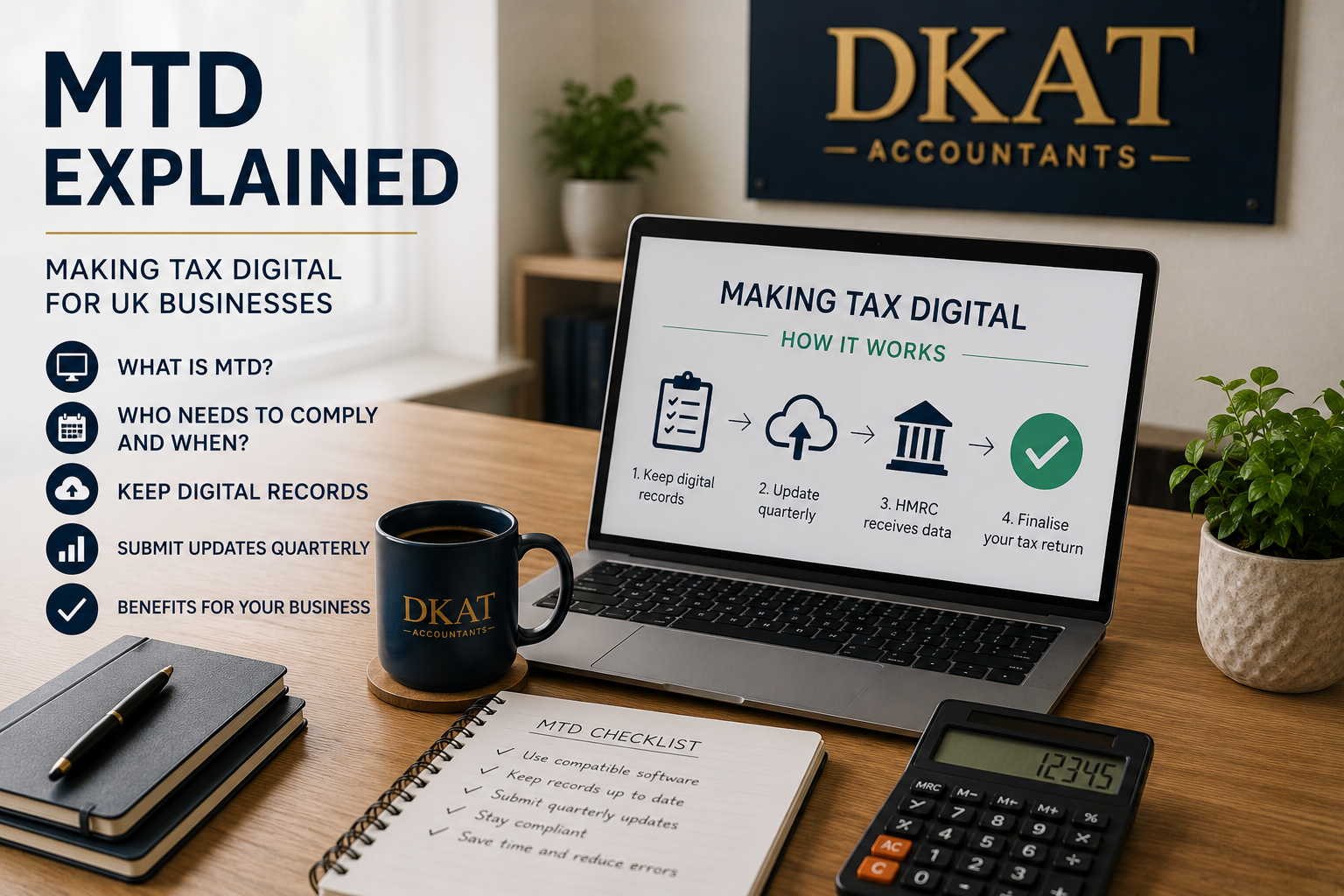
Making Tax Digital (MTD) requires taxpayers to keep digital records and submit returns to HMRC directly from compatible software rather than manual entry. MTD for VAT has been mandatory for all VAT-registered businesses since April 2022. MTD for Income Tax (MTD ITSA) became mandatory from 6 April 2026 for sole traders and landlords with qualifying income above £50,000, extending to those above £30,000 from April 2027. Affected taxpayers submit four quarterly updates a year plus an End of Period Statement and Final Declaration, instead of one annual return.
- What is Making Tax Digital?
- MTD for VAT — already mandatory
- MTD for Income Tax (MTD ITSA) — the big change
- Who is affected and when
- What quarterly updates actually involve
- End of Period Statement & Final Declaration
- Software you can use
- Penalties for non-compliance
- How to prepare now
- Frequently asked questions
Making Tax Digital (MTD) is the biggest change to UK tax administration in a generation. It replaces annual paper-based record keeping with continuous digital record keeping and in-year reporting to HMRC. If you are a sole trader, landlord, or VAT-registered business, MTD eventually applies to you — the only question is when.
This guide explains, in plain English, what MTD actually requires, who is affected and when, what software you need, and what happens if you do not comply. All references reflect the Finance Act 2016, Schedule 12 (which gives HMRC the power to make MTD regulations) and current HMRC guidance as at June 2026.
01 What is Making Tax Digital?
MTD requires affected taxpayers to: (1) keep business records digitally, in MTD-compatible software, rather than on paper or in a basic spreadsheet without bridging software; (2) submit returns or updates to HMRC directly from that software via an Application Programming Interface (API), rather than typing figures into the HMRC website by hand.
The policy was first legislated through Finance Act 2016, Schedule 12, with the VAT element introduced first (from April 2019) and the income tax element following in stages. The underlying goal, per HMRC, is to reduce the estimated £billions lost annually to error (not deliberate fraud) by removing manual data entry from the system.
02 MTD for VAT — already mandatory
MTD for VAT has been mandatory for all VAT-registered businesses since April 2022, regardless of turnover. If your business is registered for VAT (whether compulsorily because turnover exceeds £90,000, or voluntarily below that threshold), you must:
- Keep VAT records digitally using MTD-compatible software
- Submit VAT returns directly from that software via HMRC's API
- Maintain a complete digital link between any spreadsheets used and the software that submits the return — manual re-typing of figures between systems breaks the digital link requirement
If you are still filing VAT returns by typing figures into the HMRC online portal manually, you are very likely non-compliant and should address this immediately — HMRC can and does identify non-compliant filers through its systems.
03 MTD for Income Tax (MTD ITSA) — the big change
MTD for Income Tax Self Assessment (MTD ITSA) is the change most sole traders and landlords need to prepare for. It replaces the single annual Self Assessment return with quarterly digital updates plus an end-of-year finalisation, for anyone with qualifying trading and/or property income above the relevant threshold.
Key dates: MTD ITSA became mandatory from 6 April 2026 for sole traders and landlords with qualifying income above £50,000. It extends to those with income above £30,000 from April 2027, and the government has indicated an intention to extend it further to those above £20,000 in a later phase, subject to confirmation.
“Qualifying income” means gross income from self-employment and/or property, before expenses, combined across all sources. If you have £35,000 from self-employment and £20,000 from a rental property, your combined qualifying income is £55,000 — above the £50,000 threshold — even though neither source alone exceeds it.
04 Who is affected and when
| Taxpayer type | Threshold | Mandatory from |
|---|---|---|
| Sole traders & landlords | Qualifying income over £50,000 | 6 April 2026 |
| Sole traders & landlords | Qualifying income over £30,000 | 6 April 2027 |
| Sole traders & landlords | Qualifying income over £20,000 | Expected, date tbc |
| General partnerships | Not yet mandated | Date tbc — delayed from original plan |
| Limited companies | Not in scope of MTD ITSA | N/A — pay Corporation Tax instead |
| VAT-registered businesses | All, any turnover | Already mandatory since April 2022 |
Note that limited companies are not in scope for MTD ITSA — they pay Corporation Tax and file CT600, a separate regime. MTD ITSA applies specifically to unincorporated income reported via Self Assessment: self-employment and UK/overseas property income.
05 What quarterly updates actually involve
Once mandated, instead of one annual Self Assessment return, you submit four quarterly updates per tax year, summarising income and expenses for each quarter, directly from MTD-compatible software:
| Quarter | Period covered | Submission deadline |
|---|---|---|
| Q1 | 6 April – 5 July | 7 August |
| Q2 | 6 July – 5 October | 7 November |
| Q3 | 6 October – 5 January | 7 February |
| Q4 | 6 January – 5 April | 7 May |
Each update is a cumulative summary of income and expenses for that quarter — not a full tax calculation. You do not need to calculate tax liability quarterly; that happens at the end-of-year stage. The quarterly update is primarily about keeping HMRC informed in near-real-time and catching record-keeping issues early, rather than calculating tax owed.
Soft-landing penalties: HMRC has confirmed a transitional “soft landing” period during the early phase of mandation, during which late-submission penalty points accrue more leniently. This does not mean quarterly updates are optional — submissions are still required by the deadlines; the soft landing only affects how strictly the points-based penalty regime is applied initially.
06 End of Period Statement & Final Declaration
After the fourth quarterly update, two further steps complete your obligations for the tax year, both due by the usual Self Assessment deadline of 31 January following the end of the tax year:
- End of Period Statement (EOPS) — for each business or property source, you finalise the figures for the full year, applying any accounting adjustments, allowances and reliefs that don't fit neatly into quarterly reporting (e.g. capital allowances, basis period adjustments).
- Final Declaration — replaces the old Self Assessment return's final submission. It pulls together all income sources (including any not in scope of MTD, such as employment income via PAYE or dividend income) and confirms your total tax liability for the year.
The familiar 31 January payment deadline for the balance of tax owed, and the 31 July deadline for the second payment on account, remain unchanged under MTD ITSA.
07 Software you can use
You cannot submit MTD updates by typing figures into the HMRC website — everything must go through MTD-compatible software via API. HMRC publishes a list of approved software providers. Commonly used options for UK sole traders and landlords include:
- Xero — widely used, strong bank feed integration
- QuickBooks — good for businesses with inventory or multiple income streams
- FreeAgent — free with certain NatWest/RBS/Mettle business accounts, popular with freelancers
- Sage — established option, good for businesses already using Sage for payroll
- QuickFile — free tier available, suitable for very small businesses
- Bridging software — if you prefer to keep records in a spreadsheet, bridging software can connect that spreadsheet to HMRC's API, provided the digital link rules are followed throughout
08 Penalties for non-compliance
MTD ITSA introduces a points-based penalty system for late submissions, replacing the old fixed-penalty regime for the obligations it covers:
- Each missed submission deadline (quarterly update, EOPS or Final Declaration) adds one point.
- Reaching the penalty threshold (typically 4 points for quarterly filers) triggers a fixed financial penalty, currently £200, with further penalties for each subsequent missed deadline once at the threshold.
- Points expire after a period of consistent compliance (usually 24 months), resetting your position.
- Late payment of tax is penalised separately under a points-and-percentage regime, broadly: no penalty if paid within 15 days, 3% if paid 16–30 days late, and escalating percentage-plus-daily-interest penalties beyond 30 days.
Failing to register for MTD ITSA when required, or continuing to file the old-style annual return when you are mandated into MTD, can also result in HMRC raising estimated assessments and additional penalties for incorrect filing.
09 How to prepare now
- Check your qualifying income from your most recent tax return to estimate which mandation date applies to you
- Choose and set up MTD-compatible software well before your mandation date — don't wait until the deadline week
- Move from paper or basic spreadsheet record-keeping to digital record-keeping now, so the transition is not a shock
- If you have multiple income sources (self-employment plus rental property, for example), confirm how your software handles multi-source reporting
- Speak to your accountant about whether voluntary early adoption of MTD ITSA might suit you — some taxpayers join early to get comfortable with the process before mandation
- Budget for quarterly bookkeeping discipline — MTD rewards businesses that keep records up to date throughout the year rather than catching up once annually
10 Frequently asked questions
No. Quarterly updates are a running summary of income and expenses; the actual tax calculation happens once, at the Final Declaration stage after the tax year ends, exactly as it did under the old Self Assessment system.
HMRC determines whether you are mandated for a tax year based on the qualifying income reported in an earlier reference year (typically two years prior). Once mandated, you generally remain in MTD ITSA for that and subsequent years even if income later drops, subject to HMRC's specific exit rules.
Not in respect of the company's profits — those remain under Corporation Tax and CT600. However, if a director also has personal self-employment or property income above the threshold in their own name, that personal income is in scope of MTD ITSA separately.
Yes, provided it connects to HMRC via approved bridging software and the data flows through a genuine digital link with no manual re-entry at any point in the chain.
General partnerships were originally scheduled for MTD ITSA but the government has delayed mandation for partnerships pending further announcement. Sole traders and individual landlords are not affected by this delay.
Need help getting MTD-ready?
DKAT Accountants sets up MTD-compatible software, migrates your existing records, and handles quarterly updates, EOPS and Final Declaration on your behalf — all on a fixed annual fee.
Book a Free Consultation →