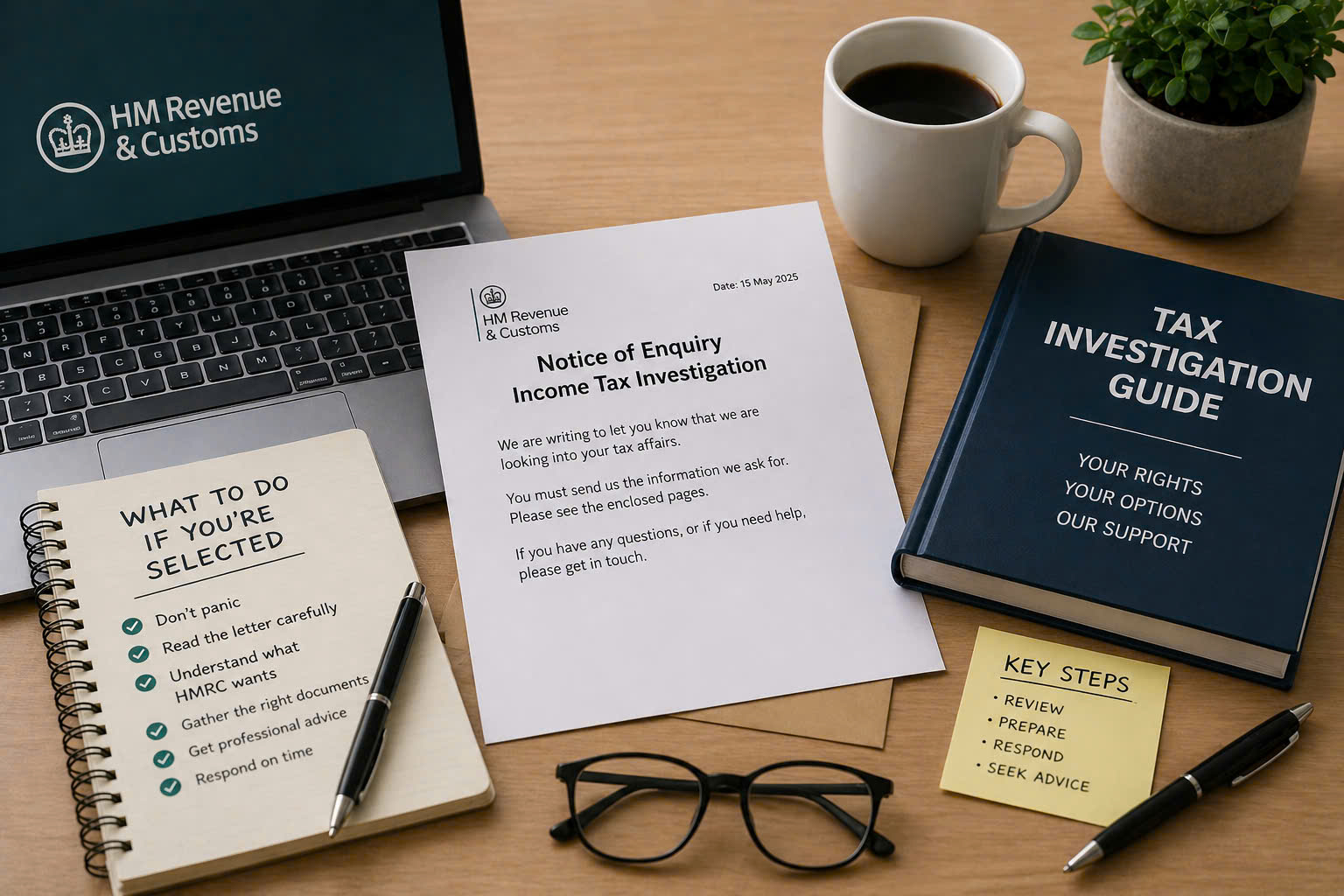
If HMRC opens a tax investigation into you or your business, do not ignore the letter or attempt to handle it entirely alone. Common investigation types include an Aspect Enquiry (focused on one part of a return), a Full Enquiry (the whole return), and the more serious Code of Practice 9 (COP9) for suspected deliberate fraud. You should respond within the stated deadline, gather the specific records requested, and strongly consider appointing an accountant to correspond with HMRC on your behalf, since HMRC can request additional information and the process can extend the scope of its review if handled poorly.
Receiving a letter from HMRC saying they are looking into your tax affairs is unsettling. Most people’s first instinct is to call HMRC and explain themselves. That is the wrong move. How you handle the opening stages of an HMRC tax investigation has a direct bearing on how it ends — how long it runs, how much additional tax HMRC tries to recover, and what penalties apply.
This guide tells you exactly what to do, and what not to do, from the moment that letter lands.
What type of HMRC investigation is this?
HMRC runs three main categories of tax enquiry. The type shapes everything that follows, including your rights and the likely outcome.
HMRC’s opening letter will typically reference the statutory basis of the enquiry. If you are unsure what you have received, do not respond until you have spoken to a qualified tax adviser.
What triggers an HMRC investigation?
HMRC uses a data-matching system called Connect, which aggregates information from banks, the Land Registry, Companies House, the DVLA, online marketplaces (including eBay, Airbnb and Etsy), letting platforms, and overseas tax authorities. When what Connect sees does not match what appears in your tax return, an enquiry flag is raised.
Common triggers include: rental income not declared or underreported; a lifestyle inconsistent with declared income (property purchases, expensive vehicles, overseas travel); business turnover that appears low relative to the industry average; a significant unexplained drop in declared income; or a purely random selection, which HMRC uses to maintain deterrence and gather compliance data.
What to do: step by step
-
1Do not contact HMRC directly. Put the letter aside. Do not call the number on the letter, do not write back without advice, and do not send messages through your HMRC online account. Every communication with HMRC during an enquiry is on the record and can be used. Anything said without preparation can inadvertently concede a point, expand the scope of the enquiry, or trigger a more invasive follow-up.
-
2Check the deadline. HMRC typically gives 30 days to respond to an initial enquiry letter. Note the date carefully. You have time — use it properly rather than rushing into a response that could make things worse.
-
3Appoint a tax specialist immediately. Contact DKAT or another HMRC investigation specialist as soon as possible. We submit a 64-8 agent authorisation form, which requires HMRC to deal with us directly and removes you from the firing line. From that point we manage all correspondence, review every document, and ensure nothing leaves without proper preparation.
-
4Gather your records — but do not send anything yet. Start collating the records relevant to the period under enquiry: bank statements, invoices, receipts, payroll records, property statements. Organise them, but hold them until your adviser has reviewed what HMRC is actually asking for and whether the request is proportionate and lawful.
-
5Do not destroy or alter any documents. Destroying documents after receiving an HMRC enquiry notice can be treated as obstruction and dramatically increases penalty exposure. Even documents you believe are irrelevant should be retained. HMRC can and does request documents across several years if the initial enquiry reveals discrepancies.
-
6Consider a voluntary disclosure if errors exist. If you know there are inaccuracies in your returns, an unprompted voluntary disclosure — made before HMRC specifically asks about the issue — attracts significantly lower penalties than a prompted one. Timing and framing are critical. A specialist adviser manages this process to minimise your exposure.
Your rights during an HMRC investigation
HMRC has significant powers, but they are not unlimited. You have the right to be represented, and once a 64-8 authorisation is in place HMRC must deal with your appointed agent rather than contacting you directly. Documents covered by legal professional privilege — correspondence with your solicitor for the purpose of obtaining legal advice — cannot be demanded by HMRC. Formal requests for information are governed by Schedule 36 Finance Act 2008: they must be in writing, and you have 30 days to comply or apply to the First-tier Tribunal to vary or set aside a notice you consider disproportionate. Informal requests carry no statutory obligation to comply, though cooperation is generally advisable.
How HMRC calculates penalties
If additional tax is found to be due, HMRC calculates a penalty as a percentage of the Potential Lost Revenue (PLR) — the extra tax arising from the enquiry. The rate depends on the taxpayer’s behaviour and whether the disclosure was prompted or unprompted by HMRC:
- Reasonable care, genuine error: no penalty
- Careless, unprompted disclosure: 0–30% of PLR
- Careless, prompted disclosure: 15–30% of PLR
- Deliberate inaccuracy, unprompted: 20–70% of PLR
- Deliberate inaccuracy, prompted: 35–70% of PLR
- Deliberate and concealed, unprompted: 30–100% of PLR
- Deliberate and concealed, prompted: 50–100% of PLR
Penalties are reduced for quality of disclosure across three dimensions: telling (what was wrong), helping (providing information promptly and fully), and giving (access to records). A specialist who manages the disclosure process correctly can significantly reduce the final penalty percentage even where additional tax is clearly owed. HMRC interest on unpaid tax accrues from the original due date at the Bank of England base rate plus 2.5% and cannot be negotiated away.
How DKAT protects your position
When you appoint DKAT as your representative, we take over all communication with HMRC immediately. We review every piece of correspondence before it is sent, assess the scope of the enquiry, identify any legitimate challenges to HMRC’s requests, prepare your records accurately and in the most favourable light, manage voluntary disclosures where appropriate, and represent you through to closure. Our involvement typically shortens investigations, reduces the amount of additional tax HMRC seeks to recover, and minimises penalty exposure.
We also advise on tax investigation fee protection insurance — which covers professional fees during an enquiry and which many business owners and landlords hold without realising it through their business or home contents insurer. We can check your existing policies and advise on stand-alone cover going forward.
FAQ Frequently asked questions
An Aspect Enquiry into one issue may resolve in a few weeks to a few months. A Full Enquiry examining an entire tax return can take 6 months to over a year. COP9 investigations, involving suspected serious fraud, often take significantly longer given their complexity.
Selection can be random, risk-based (using HMRC's Connect data-matching system to spot inconsistencies), or triggered by a specific red flag such as a large repayment claim, an industry known for cash transactions, or a tip-off. Being selected does not mean HMRC believes you have done anything wrong.
HMRC can formally request records reasonably required to check your tax position under Schedule 36, Finance Act 2008. You can challenge unreasonable or disproportionate requests, ideally with professional representation, but outright refusal of a valid formal notice can lead to penalties.
Most investigations are civil matters resulting in additional tax, interest and penalties rather than prosecution. Criminal prosecution is reserved for cases of serious, deliberate fraud and is relatively rare, though COP9 investigations specifically address this risk.
Yes. Early professional representation typically leads to a smoother, faster resolution, ensures you do not inadvertently expand the scope of the enquiry, and helps present your position to HMRC in the clearest and most accurate way from the outset.
Received an HMRC letter? Contact DKAT today.
Do not respond to HMRC until you have spoken to us. We handle HMRC investigations for individuals, sole traders, landlords and limited companies across London and the UK. The initial call is free, confidential and carries no obligation. The sooner you contact us, the more options we have to protect your position.
Get Help Now →Important notice: This article is for general information and educational purposes only. It does not constitute tax, legal or financial advice. HMRC investigation procedures are complex and fact-specific — individual circumstances vary significantly and professional advice should be sought before responding to any HMRC correspondence. Penalty percentages cited reflect HMRC’s published Compliance Handbook (CH) guidance current at the date of writing (May 2026) and are subject to change. Statutory references (Section 9A TMA 1970, Schedule 36 Finance Act 2008) are correct at the date of writing. DKAT Accountants is regulated by the Association of Chartered Certified Accountants (ACCA). This article does not constitute a financial promotion.