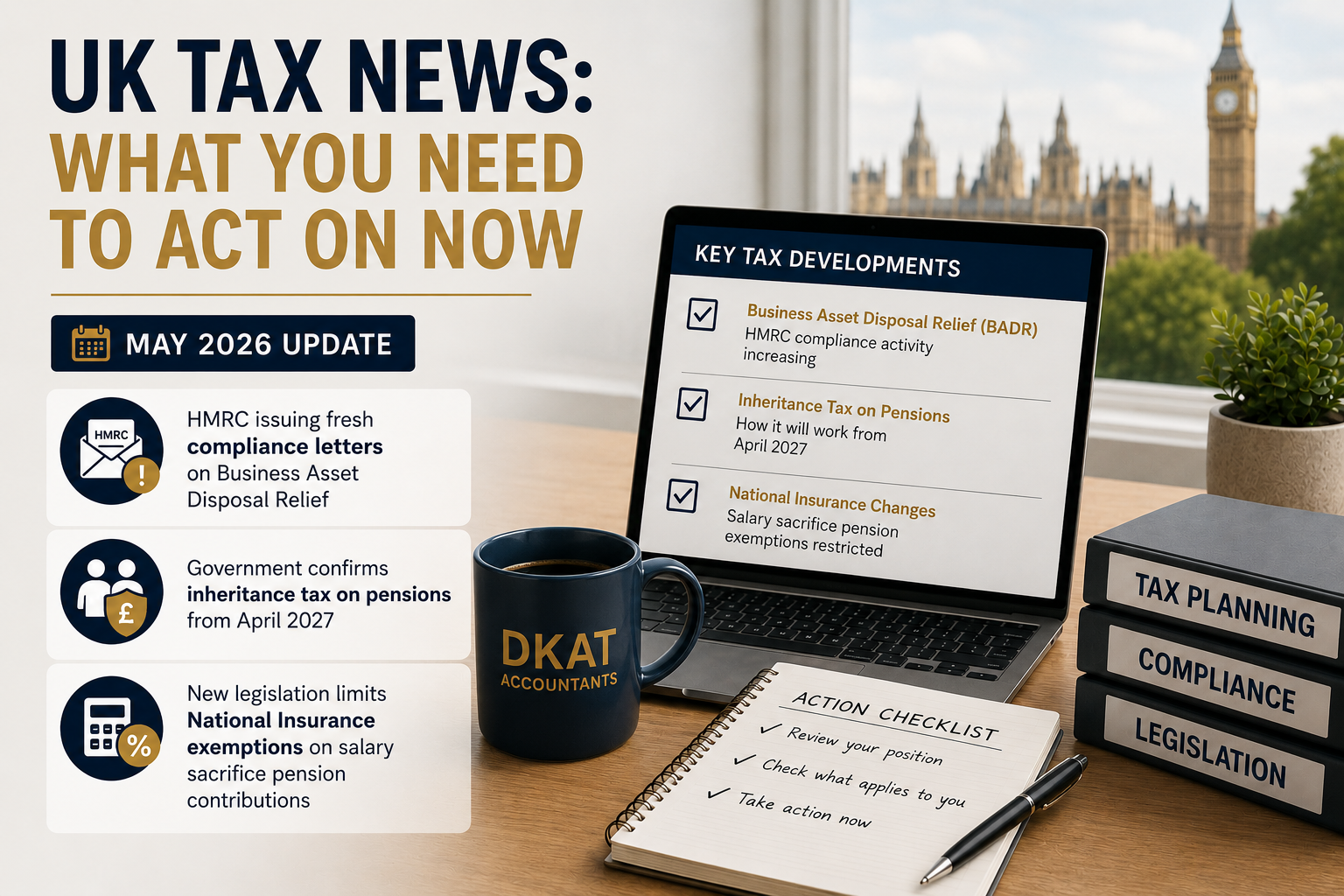
The Spring Statement 2026 is the Chancellor's mid-year economic update, distinct from the annual Autumn Budget where most major tax changes are announced. It typically confirms economic forecasts from the Office for Budget Responsibility and may include smaller fiscal adjustments, but rarely introduces the significant tax rate or threshold changes seen in a full Budget. Taxpayers and businesses should treat it as a forecast checkpoint rather than an event requiring immediate action, unless specific measures are announced.
- The headlines: what was and wasn't announced
- Dividend tax rates rise from April 2026
- BADR rate rises to 18% from 6 April 2026
- Business and Agricultural Property Relief cap
- Making Tax Digital for Income Tax launches
- Frozen thresholds: the silent tax rise continues
- Capital allowances: writing-down rate reduced
- What the OBR economic outlook means for future budgets
- What you should do now
- FAQ - Frequently asked questions
On 3 March 2026, Chancellor Rachel Reeves delivered the Spring Statement — a deliberately low-key affair focused on economic forecasts rather than new policy. No new tax rises were announced. However, the absence of fresh bad news is not the same as good news. A cluster of significant tax changes, locked in at the 2024 and 2025 Autumn Budgets, take effect from 6 April 2026 — the start of the 2026/27 tax year — and their combined impact is substantial for company directors, landlords, business owners and investors.
This article sets out every material development from the Spring Statement and the confirmed April 2026 changes, with clear guidance on what each means for your tax position.
The headlines: what was and wasn't announced
The Spring Statement confirmed the government's commitment to one major fiscal event per year (the Autumn Budget). The statement included no new tax policy changes, no adjustments to income tax rates or thresholds, no relief for businesses on the rising cost of employer National Insurance, and no reversal of the dividend tax increases already legislated.
The OBR revised its growth forecast for 2026 downward to 1.1% (from a previous estimate of 1.5%), citing ongoing geopolitical uncertainty, higher energy costs, and the lagged effects of higher employer NI. The Chancellor's fiscal headroom improved modestly to £23.6 billion (from £21.7 billion at the Autumn Budget), largely due to stronger capital gains tax receipts — but the OBR cautioned this remains tight and could be eroded by future spending pressures.
Dividend tax rates rise from 6 April 2026
This is the change with the widest direct impact on company directors and shareholders. From 6 April 2026, the rates of income tax on dividend income increase as follows:
| Taxpayer band | Rate in 2025/26 | Rate from 6 April 2026 | Increase |
|---|---|---|---|
| Basic rate | 8.75% | 10.75% | +2% |
| Higher rate | 33.75% | 35.75% | +2% |
| Additional rate | 39.35% | 39.35% | No change |
The dividend allowance remains at £500 for 2026/27. The increase applies to all dividend income above this allowance, regardless of its source. The Spring Statement confirmed that no adjustment would be made to soften this rise.
For a higher-rate taxpayer taking £50,000 in dividends from their company each year, the 2% increase costs an additional £1,000 in tax per year. For a director extracting £100,000 in dividends, the additional cost is £2,000. This compounds each year against a backdrop of frozen income tax thresholds and rising employer NI.
Business Asset Disposal Relief rate rises to 18%
Business Asset Disposal Relief (BADR) — which reduces CGT on qualifying business disposals such as shares in your own trading company, business assets used in a trade, and qualifying partnerships — increases in rate from 14% to 18% from 6 April 2026. The £1 million lifetime limit on qualifying gains is unchanged.
| Period | BADR rate |
|---|---|
| Before 30 October 2024 | 10% |
| 30 October 2024 – 5 April 2026 | 14% |
| From 6 April 2026 | 18% |
The 18% rate matches the main CGT rate for basic rate taxpayers, meaning BADR no longer represents the same relative advantage it once did for lower-rate taxpayers. For higher-rate taxpayers, BADR at 18% still saves 6% compared to the standard 24% rate on the same gain.
Business Property Relief and Agricultural Property Relief cap confirmed
From 6 April 2026, the inheritance tax 100% relief on qualifying business and agricultural assets (Business Property Relief and Agricultural Property Relief) is capped at a combined £2.5 million per person. Assets above this cap attract 50% relief — effectively an IHT rate of 20% on the excess, rather than the previous 0%.
The Finance (No.2) Bill confirmed the implementation provisions. The cap applies per individual and is transferable between spouses and civil partners, giving eligible couples a combined effective shelter of up to £5 million at 0% IHT (on top of their standard nil-rate bands). Assets above £2.5m per person face a 20% effective IHT rate.
The Spring Statement confirmed no relaxation of this change, despite significant lobbying from farming and business groups. Business owners and farmers with qualifying assets above £2.5 million should treat this as urgent — the window for planning ahead of the change is now extremely narrow.
Making Tax Digital for Income Tax launches 6 April 2026
Making Tax Digital for Income Tax Self-Assessment (MTD ITSA) begins its mandatory rollout on 6 April 2026 for sole traders and landlords whose combined gross income from self-employment and UK property exceeded £50,000 in the 2024/25 tax year. The traditional annual self-assessment return does not disappear immediately, but the quarterly reporting cycle starts from this date for those in scope.
| Income threshold | Mandatory from |
|---|---|
| Over £50,000 gross (self-employment + property) | 6 April 2026 |
| Over £30,000 gross | 6 April 2027 |
| Over £20,000 gross | 6 April 2028 |
Quarterly update deadlines under MTD for the 2026/27 tax year are 7 August 2026, 7 November 2026, 7 February 2027 and 7 May 2027, followed by an End of Period Statement and a Final Declaration by 31 January 2028. HMRC has confirmed a soft-landing penalty period for 2026/27 — no points will be issued for late quarterly updates during this first year, though the obligation to submit still applies.
Limited company directors are not affected by MTD ITSA. The change applies to individuals (unincorporated businesses and individual landlords) only.
Frozen thresholds: the silent tax rise continues
The income tax personal allowance (£12,570) and higher rate threshold (£50,270) remain frozen until at least April 2031. With wages continuing to rise, each year more people are pulled across the basic-rate threshold and into higher-rate tax — without any change to the headline rate. The OBR estimates this fiscal drag will add billions to HMRC's receipts over the freeze period.
The Spring Statement introduced no relief from this. Combined with the 2% dividend tax increase and higher employer NI, the effective tax burden on working people and business owners continues to rise in 2026/27 even though no new rates were announced on 3 March.
Capital allowances: writing-down rate reduced
From 6 April 2026, the main rate writing-down allowance (WDA) on the general pool of plant and machinery reduces from 18% to 14%. This means businesses that do not fully use the Annual Investment Allowance (£1 million) will write down qualifying assets more slowly, delaying relief on capital investment. The Annual Investment Allowance itself is unchanged.
A new first-year allowance for certain qualifying investments also took effect from January 2026, providing 100% first-year relief on qualifying new assets as an alternative to the AIA where eligibility differs.
What the OBR economic outlook means for future budgets
The OBR's Spring forecast paints a challenging picture. Growth has been revised down, living standards are expected to stagnate, and public sector debt remains elevated. The OBR explicitly noted that its forecast was prepared before the escalation of tensions in the Middle East, which has already affected energy prices and could alter several key assumptions.
The practical implication: the Chancellor's fiscal headroom remains fragile. If growth disappoints or spending pressures mount, the next Autumn Budget could include further tax measures. This makes proactive tax planning now — before another fiscal event — particularly valuable. Locking in planning decisions under known rates is always preferable to reacting to future changes.
What you should do now
The Spring Statement itself required no immediate action. The changes that matter were already in train. Here is a practical checklist:
- Company directors: Model your optimal salary and dividend split for 2026/27 under the new 10.75%/35.75% dividend rates. Consider maximising employer pension contributions before extracting further dividends.
- Business sellers: Confirm your BADR rate. If your transaction has completed or will complete from 6 April 2026, the 18% rate applies. Ensure this is reflected in your tax planning.
- Business owners and farmers with assets above £2.5m: The BPR/APR cap is now in force. Engage a specialist immediately to model your IHT exposure and explore available mitigation strategies.
- Sole traders and landlords with gross income over £50,000: MTD ITSA is mandatory from 6 April 2026. If you are not already using MTD-compatible software and submitting quarterly updates, you are out of compliance. Contact DKAT now.
- All taxpayers: The frozen thresholds and rising dividend rates mean your effective tax rate is almost certainly higher in 2026/27 than it was in 2025/26, even if you have done nothing different. A tax review is worthwhile for anyone earning above £50,000.
FAQ Frequently asked questions
The Spring Statement is a smaller mid-year economic update presenting official OBR forecasts, with the Chancellor traditionally reserving major tax and spending decisions for the Autumn Budget. Since 2017, the government has aimed to make major fiscal announcements once a year to give businesses more certainty, using the Spring Statement mainly for forecast updates rather than new measures.
The Spring Statement is not typically used to introduce significant new tax measures, which are usually reserved for the Autumn Budget. Any specific announcements made should be checked against official HMRC and HM Treasury publications, as detail can vary year to year depending on the fiscal and economic circumstances at the time.
Generally, only if specific rate, threshold or relief changes were announced that directly affect your circumstances. Given the Spring Statement's traditional role as a forecast update, most personal and business tax planning should continue to be reviewed around the Autumn Budget and the start of the new tax year in April.
The full Spring Statement report, OBR Economic and Fiscal Outlook, and any accompanying tax information notes are published on GOV.UK and the Office for Budget Responsibility website on the day of the statement.
Its effect depends entirely on what is announced in a given year. Small businesses should watch for any updates to thresholds (such as VAT registration), Employment Allowance, business rates relief, or economic forecasts that might signal future policy direction ahead of the next Budget.
Not sure how these changes affect you?
The April 2026 changes are detailed, overlapping, and affect different people in different ways. Our FCCA-qualified advisors can review your specific position — director salary structure, BADR eligibility, BPR exposure, MTD readiness — and give you a clear action plan. The consultation is free and there is no obligation.
Book Your Free Consultation →Important notice: This article is based on the Spring Statement delivered on 3 March 2026 and the Finance (No.2) Bill 2026 as at the date of writing. All rates, thresholds and policy changes referred to are based on publicly available HMRC and OBR guidance. This article is for general information and educational purposes only and does not constitute tax, legal or financial advice. You should not rely on this article as the basis for any financial or tax decision without first taking professional advice tailored to your individual circumstances. DKAT Accountants is regulated by the Association of Chartered Certified Accountants (ACCA). This article does not constitute a financial promotion.